
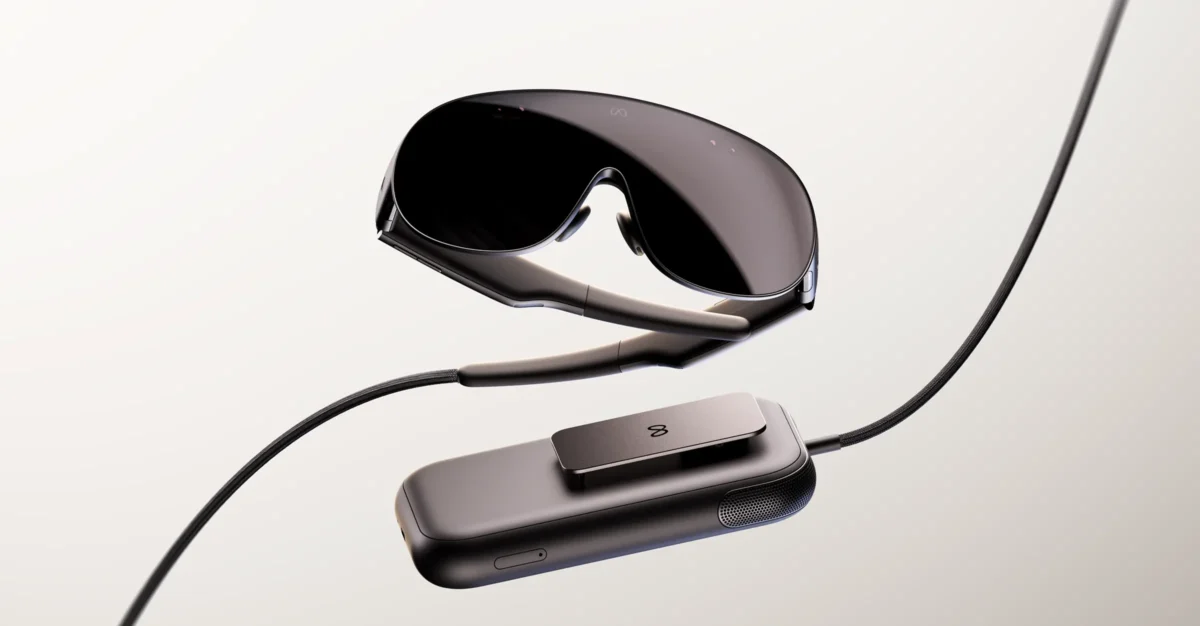
Meta has unveiled its most ambitious hardware in years. At its annual Connect developer conference Wednesday, CEO Mark Zuckerberg revealed the Meta VR Glasses — a dramatically slimmer successor to the Quest line of headsets, priced at $1,299 and launching in spring 2027 — alongside a handheld AI companion device called the Muse Charm that allows users to interact with their Meta AI agents without touching a phone.
The Meta VR Glasses represent the company’s first new VR device since the $299 Quest 3S debuted in 2024, and they are a fundamental rethinking of the form factor. Rather than a single headset unit with a built-in processor and battery, the glasses offload compute, battery, and storage to a small external puck that clips to a pocket or bag, connected to the glasses by an optical tether. The result weighs approximately 100 grams — five times lighter than the Meta Quest 3 — and sits on the face without straps or heavy hardware.
“We have built a new kind of VR device that delivers the same magical feeling of presence and immersion, high-resolution displays and views of the world around you in a form factor that is a pair of glasses for the first time,” Zuckerberg said on stage.
What the VR Glasses Can Do
The display is a 5K panel built on micro-OLED technology with 37 pixels per degree — a specification Meta says delivers cinema-grade text legibility and image clarity. Ultra-compact pancake lenses developed specifically for the device are what make that visual quality possible in the slim form factor. The glasses support Dolby Vision for colour and contrast, and Dolby Atmos spatial audio is integrated directly into the frames.
The processor is Qualcomm’s new Snapdragon Reality Elite chip. The puck’s battery delivers up to three hours of continuous high-resolution media playback, with 45W fast charging supported.
Interaction is designed to be controller-free by default. Eye tracking and hand gesture recognition are built into the glasses, and Meta AI is integrated directly into the operating system. Users can speak, look, or gesture to launch apps, control media playback, adjust workspaces, or search without picking up a controller. Touch Plus controllers are still fully supported for gaming.
The glasses are the first IMAX Enhanced certified VR device ever made. They will also be able to run immersive 3D versions of films including Avengers: Infinity War and Star Wars: A New Hope through a new Disney Immersive Cinema app by ILM at launch. Disney+ subscribers will be able to stream Marvel and Disney films in 3D in select countries from November, with immersive environments including Tatooine, Avengers Tower, and Scare Floor. Director James Cameron is involved in a partnership to debut “first time in 3D” blockbusters in 2027, alongside filmmaker Matthew Vaughn’s upcoming Stuntnuts in a 3D exclusive.
Sports partnerships include ESPN Immersive Sports coverage beginning with college football this year and over 100 immersive live sports events annually at launch, via MLB, NBC Sports, TNT Sports, and UFC. All existing Meta Quest titles — thousands of games — are fully compatible, alongside 75 new titles at launch playable with hand gestures alone. Xbox Cloud Gaming is also supported via Bluetooth gamepad.
The Hologram Call Feature
One of the more striking capabilities announced is photorealistic holographic video calling. Meta VR Glasses will create a real-time digital representation of the user — capturing facial expressions and reactions — that appears spatially positioned in front of whoever they’re talking to, with spatial audio placing the voice where the person appears. Users on phones or computers see the hologram on their screen. The feature works across WhatsApp, Zoom, and other calling apps.
The Muse Charm
Zuckerberg also revealed the Muse Charm — a small handheld device designed to give users quick access to their Meta AI personal agent when they are not wearing the VR Glasses or Ray-Ban smart glasses. He described it as “by far the fastest way to talk to your Muse and to show it what’s going on around you” for users not wearing glasses. It contains a camera for showing the AI what’s in front of you. Price and full specifications have not been announced. Meta said it plans to ship the device in time for the December holiday season.
Stay informed. Subscribe to the JournalTodays Newsletter for the latest Meta news, VR technology coverage, and consumer electronics updates delivered straight to your inbox.