
FIFA is fighting fires on two fronts at the 2026 World Cup. Its refereeing chief has gone public to dismiss allegations of bias after Egypt’s furious reaction to their Round of 16 defeat by Argentina, while separately, FIFA president Gianni Infantino faces growing institutional pressure over his relationship with the Trump administration — pressure that has triggered formal complaints to both the FIFA Ethics Committee and the International Olympic Committee.
The two controversies are separate but are combining to create the most turbulent period for football’s governing body at a major tournament in years — and both are playing out in real time as the competition heads into the quarterfinals.
Egypt’s Allegations and FIFA’s Response
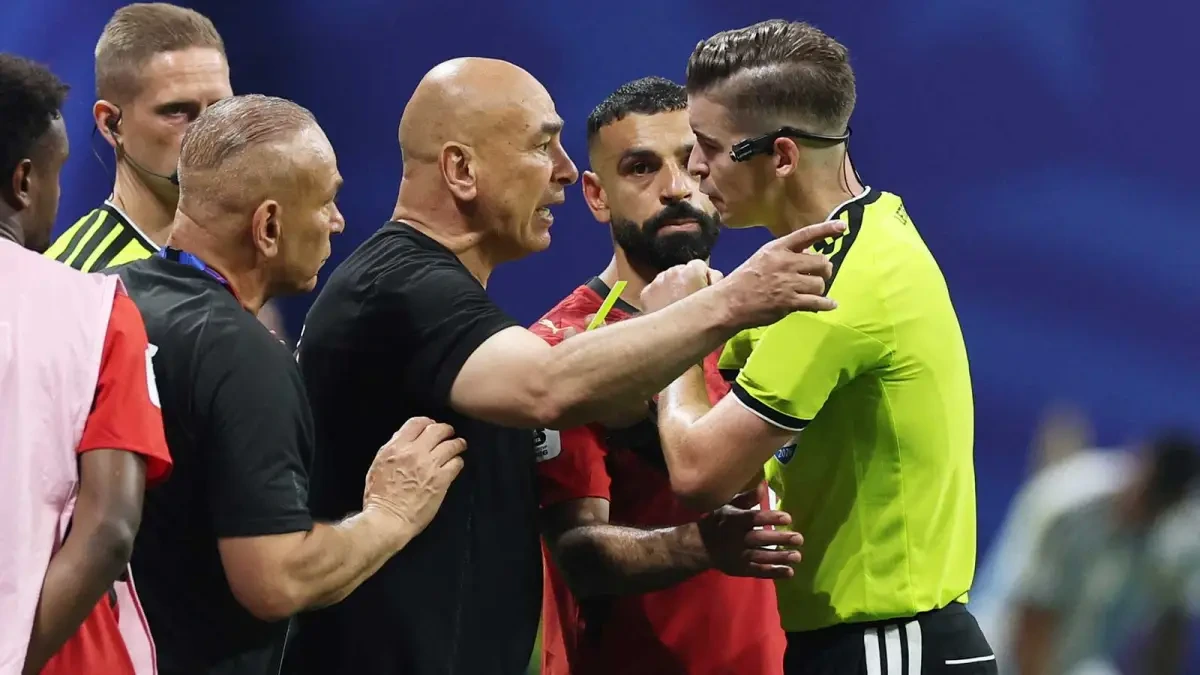
Argentina’s 3-2 win over Egypt in the Round of 16 was one of the most dramatic results of the tournament — a 2-0 deficit overturned with 11 minutes remaining, sealed by an Enzo Fernandez stoppage-time winner. Egypt left the tournament furious, and their anger was directed squarely at the officials.
Egypt coach Hossam Hassan alleged after the match that there may have been pressure on the referee to keep Argentina alive in the competition, and that his team had been “cheated” out of a quarterfinal place. The Egyptian Football Association went further, saying it would not remain silent over what it described as the improper use of VAR, specifically targeting two decisions that it believes cost Egypt the match.
The first was the disallowance of Mostafa Zico’s second-half goal, ruled out after VAR identified a foul by Marwan Attia on Argentina defender Lisandro Martinez during the attacking possession phase. Egypt argued the foul was non-existent. The second was the failure to award Egypt a penalty for a challenge on Mohamed Salah moments before Argentina launched the move that produced the winner.
FIFA refereeing chief Pierluigi Collina responded in an interview published on FIFA’s official website on Thursday. His defence of both decisions was clear. On the disallowed goal, Collina said VAR had correctly intervened: “We believe that a foul is a foul. Regardless of whether the foul appears ‘obvious’, if the referee did not see it on the field of play, the VAR can intervene.” On Salah’s challenge, he said both the referee and VAR had judged the contact with Julian Alvarez to be “normal football contact” — explaining that a defender who plays the ball first and then makes normal physical contact has not committed a foul.
Collina did not stop at defending the decisions. He escalated the language significantly, warning that allegations of the kind Egypt had made could endanger officials personally. “Nobody can question the integrity of the FIFA World Cup match officials. Equally, nobody can claim that FIFA refereeing can be influenced by anyone, not even by the FIFA president,” he said. “Unfounded allegations have no place in our sport.” He acknowledged that some decisions would always involve an element of subjectivity but said FIFA was satisfied with how VAR principles had been applied throughout the tournament.
ALSO READ: World Cup 2026 Quarterfinals: France, Spain and Argentina Lead the Eight Remaining Teams
Infantino’s Separate — and Larger — Problem
The refereeing row is not the only controversy engulfing FIFA’s leadership at this World Cup. Infantino faces serious institutional scrutiny over his handling of the suspension resulting from US striker Folarin Balogun’s red card in the Round of 32. The suspension was subsequently lifted in what sources described as a reversal instigated after a phone call from President Trump to Infantino. Belgium, who beat the United States 4-1 in the Round of 16, made their feelings about that episode publicly clear in their post-match celebrations.
Human rights group FairSquare has announced plans to file a complaint with the International Olympic Committee over Infantino’s “repeated breach of political neutrality rules,” specifically citing his relationship with Trump. This follows a separate complaint FairSquare filed with the FIFA Ethics Committee in December 2025, based on multiple instances in which Infantino publicly expressed support for Trump’s actions and policies — including awarding Trump a FIFA Peace Prize that did not previously exist as an official honour.
At least 35 European lawmakers have separately written to the national football associations of EU member states asking them to request a FIFA Ethics Committee investigation into whether political pressure from the US government influenced the lifting of Balogun’s suspension, and into other potential breaches of Infantino’s political neutrality obligations. The European Parliament intervention was reported by the Associated Press.
The two lines of controversy — Egypt’s allegations of bias in Argentina’s favour and the documented account of Trump influencing Balogun’s suspension — are not officially connected. But they are feeding a single narrative: that FIFA under Infantino is susceptible to pressure from powerful political actors in ways that compromise the integrity of the tournament. Whether any formal investigation will produce findings, and on what timeline, remains unclear. What is clear is that the controversy is not fading as the tournament moves toward its final stages.
Stay informed. Subscribe to the JournalTodays Newsletter for the latest World Cup 2026 news, football coverage, and sports updates delivered straight to your inbox.