
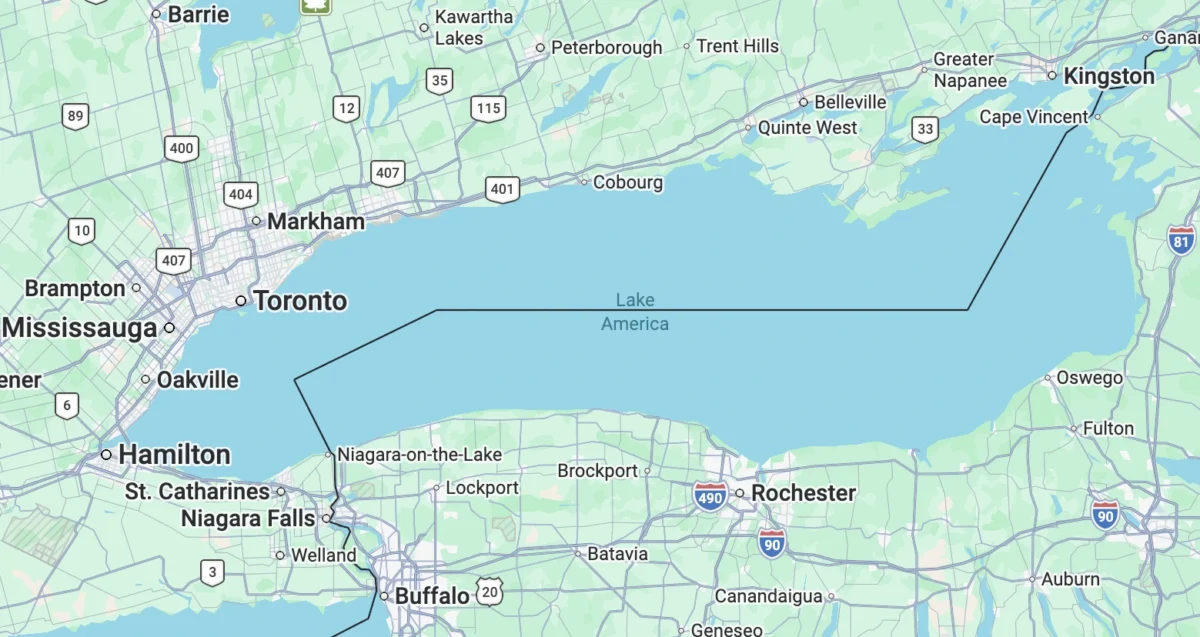
Google has updated its Maps application to display Lake Ontario as “Lake America” for users in the United States, following an executive order signed by President Trump last week as trade tensions with Canada continue to escalate. Users in Canada will continue to see the name Lake Ontario. Those outside both countries will see both names displayed simultaneously.
Google said in a blog post that the change follows its standard practice of reflecting names given by the US Geographic Names Information System (GNIS). The tech giant made the same adjustment last year when Trump renamed the Gulf of Mexico as the Gulf of America — a precedent that established Google’s approach to federally mandated geographic name changes.
Trump’s decision to rename the lake was met with derision in Canada and attracted widespread mockery online. The president leaned in, posting an AI-generated video depicting ducks armed with semiautomatic weapons, wearing his signature hairstyle, and appearing to defend a lake bearing a sign reading “Lake America.”
Canada’s Response
Canadian Prime Minister Mark Carney responded with a statement rooted in history rather than outrage. “We know that America is changing. Their trading relationships, their foreign policies, their national monuments, their hydronyms,” Carney wrote on social media. “Canadians also know that naming reality means calling it Lake Ontario — then, now and always.”
Carney noted that Ontario is a historical Indigenous name for the lake that predates the creation of both Canada and the United States. Ontario Premier Doug Ford appeared on the ABC programme This Week on Sunday, describing Trump’s decision as something “out of Saturday Night Live.” He unveiled a large sign near the lake in Winona, Ontario, reading “Lake Ontario Now and Always” in both English and French.
“No one’s going to call it Lake of America. It’s been Lake Ontario for hundreds of years. It’s going to continue being Lake Ontario,” Ford said.
The Broader Context
The renaming is one front in a rapidly expanding dispute between the United States and Canada. Trade talks between the two countries collapsed on August 21st when Carney walked away from what he called a “bad deal” that would harm Canada’s economy and sovereignty. That breakdown triggered new US tariffs on Canadian goods, with Canadian retaliatory tariffs on American goods expected to take effect September 8th.
Trump has since revived his longstanding comments about Canada becoming the 51st state and called Carney and Canadian leadership “nasty.” Canadians have rallied behind Carney but are bracing for the economic consequences of a prolonged dispute with their largest trading partner.
Whether Apple will follow Google in renaming the lake for US users remains unclear. The company changed the Gulf of Mexico to Gulf of America last year but had not responded to a request for comment at the time of publication.
Stay informed. Subscribe to the JournalTodays Newsletter for the latest US-Canada news, trade war coverage, and current affairs updates delivered straight to your inbox.