
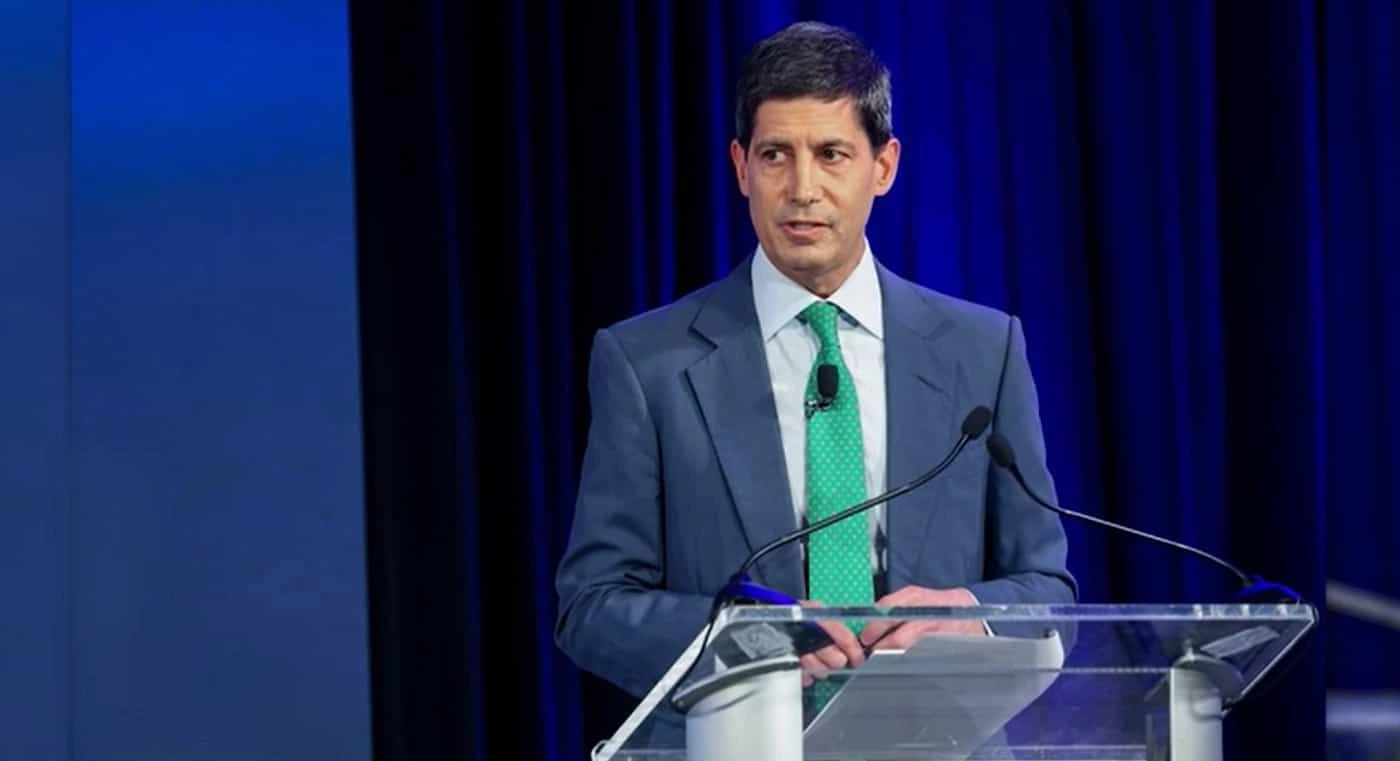
Kevin Warsh‘s first meeting as Federal Reserve chairman arrives at one of the more complicated moments in recent monetary policy history. Rising inflation, a recent US-Iran peace agreement that has not yet been formally signed, and a deeply divided committee will all be in play when the Federal Open Market Committee meets Wednesday to decide on the path forward for interest rates.
The economic backdrop is challenging. Wholesale business inflation surpassed 6% in May and overall consumer inflation rose above 4%, both driven significantly by the energy shock tied to the Iran war. Oil prices remain 30% higher than where they started the year, though the recent peace agreement has begun easing some of that pressure ahead of Warsh’s debut at the helm.
The central bank is widely expected to hold rates unchanged at this meeting. The Fed’s rate-setting committee typically avoids shifting monetary policy in direct response to volatile energy price swings, preferring to see how conditions develop following a major geopolitical shift like the Iran agreement before making structural changes to its approach.
Why This Meeting Matters Beyond the Rate Decision
What investors are actually watching for is not the rate decision itself, but everything around it — Warsh’s first public appearance as chairman, and what it reveals about how he intends to run the institution. “We expect the press conference to be pivotal,” UBS economists wrote in a note this week. “This will be Kevin Warsh’s first public appearance as Chair of the Federal Open Market Committee. That creates considerable uncertainty.”
The political backdrop adds another layer. President Trump told reporters in February that he would not have nominated Warsh unless he believed Warsh would lower interest rates quickly. More recently, Trump has shifted his public posture, saying he told Warsh he was free to “do your own thing” on interest rate policy — a notable loosening of the pressure that defined Warsh’s early nomination period.
The Dot Plot Question
One of the most closely watched elements of Wednesday’s meeting is whether Warsh will participate in the so-called dot plot — the quarterly chart tracking where individual Fed policymakers expect interest rates to move over coming years, part of the central bank’s broader Summary of Economic Projections. Warsh has previously argued that the Fed provides too much forward guidance to markets and the public, and economists at multiple major banks now expect him to decline submitting his own projections entirely.
“While Warsh dislikes forward guidance and may not need a formal vote to scrap it, doing so risks antagonizing colleagues, especially given Powell’s communication review last year found no majority support for changes,” wrote Bank of America’s economics team. Goldman Sachs economist David Mericle reached a similar conclusion, writing: “We assume that Chairman Warsh will not submit dots in light of his past criticism of forward guidance.”
Warsh is not alone in his skepticism. Former Fed chair Jerome Powell, who remains on the rate-setting committee as a governor, said in April: “I was never the world’s biggest fan of the dot plot. But you can’t beat something with nothing.”
The dot plot has a relatively short history. The broader Summary of Economic Projections was introduced in 2007, but the dot chart itself was added in 2012, in the aftermath of the financial crisis, when interest rates were pinned near zero and the Fed was buying trillions of dollars in bonds to support the economy. Both Ben Bernanke and his successor Janet Yellen used the projections as a form of forward guidance to give markets greater clarity on the likely path of policy.
The last dot plot, released in March, showed Fed officials still expecting just one rate cut in 2026 — unchanged from December’s forecast on the surface, but masking sharp internal disagreement. Seven officials projected one cut, seven saw no cuts at all, two anticipated two cuts, two expected three, and one projected four. Given persistent inflation pressures and a labour market that has remained more resilient than expected, any projections released this time could shift higher still — with some officials potentially even pencilling in the possibility of rate hikes rather than cuts. Markets have already begun pricing in that risk.
The volatility in the projections underscores one of the central criticisms of forward guidance generally: officials signal a policy path based on the information available at a specific moment, and that signal can become outdated quickly as conditions change. Supporters counter that the tool remains valuable precisely because it gives businesses, consumers, and investors a clearer sense of how policymakers are thinking — insight that matters because borrowing costs across mortgages, auto loans, and business financing are all tied closely to where the Fed signals it intends to go.
Stay informed. Subscribe to the JournalTodays Newsletter for the latest economic news, Federal Reserve coverage, and financial markets updates delivered straight to your inbox.