
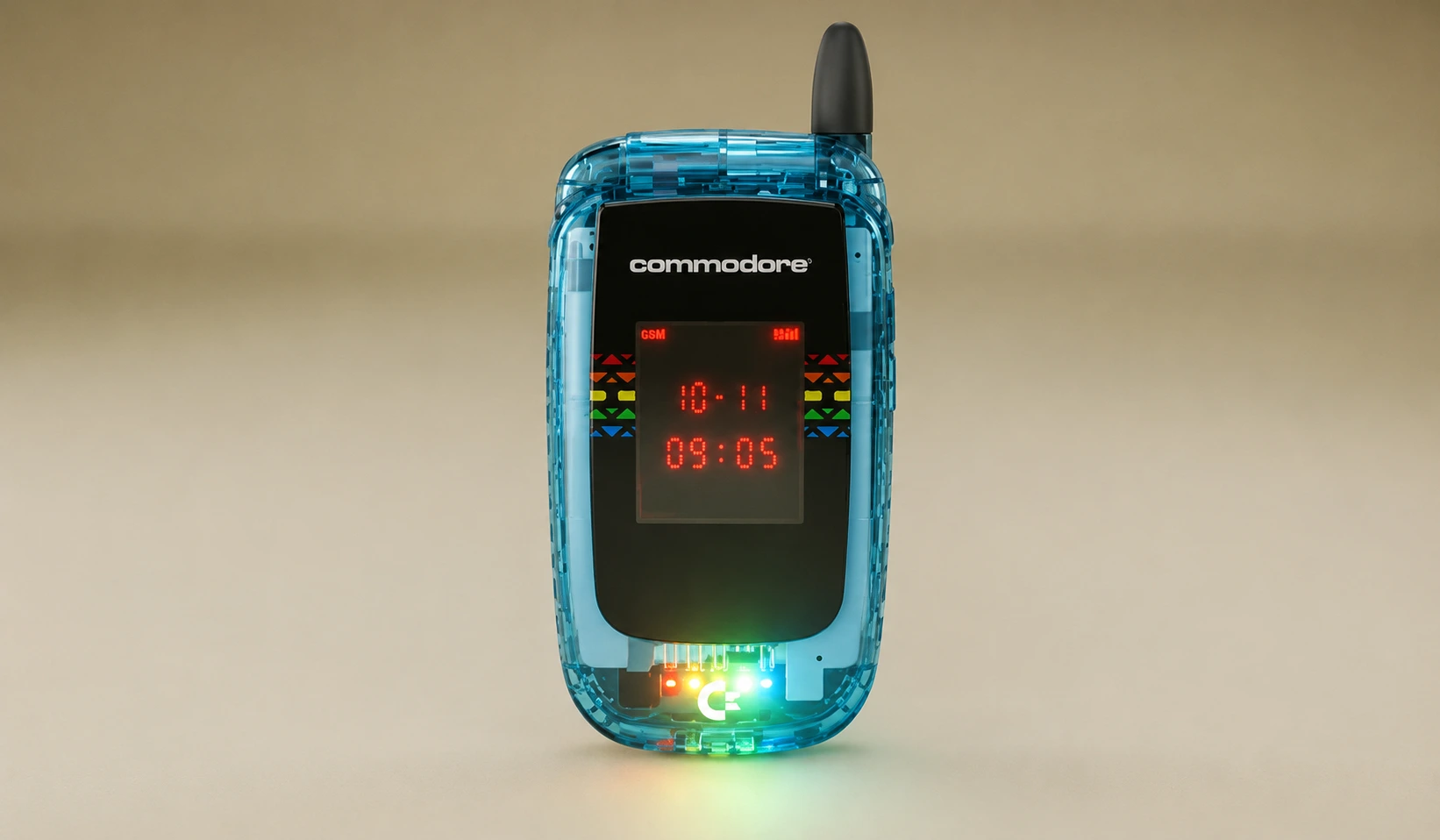
Commodore, the brand behind the bestselling desktop computer in history, has unveiled its strangest comeback product yet: a flip phone. The Commodore Call Back 8020 leans into renewed consumer interest in simpler, less distracting devices — blocking web browsers and social media access at the system level while still offering internet-connected features like maps and QR codes.
The new Commodore brand emerged roughly a year ago when Christian Simpson — known online as Peri Fractic, host of the Retro Recipes YouTube channel — acquired the Commodore Corporation along with 100% of its original trademarks dating back to 1983, reportedly for a price in the low seven figures. The brand’s earlier releases under new ownership, the Commodore 64 Ultimate and the Commodore 64X mini PC, leaned heavily on nostalgia for the original hardware. The Callback 8020 represents something different — a genuinely new product built around old principles rather than a re-release of vintage technology.
How the Phone Blocks Social Media
Commodore’s approach to restricting distracting apps goes well beyond a simple settings toggle. The phone’s app store, Commostore, operates on a whitelisting principle — social media platforms and web browsers will never be added to that whitelist, according to Simpson. The company has also developed patent-pending technology specifically designed to prevent those apps from being sideloaded onto the device, even though users can sideload nearly anything else they want.
As a backstop, Commodore has blocked access at the DNS level. Even if someone managed to find a workaround and install a blocked app, the device would be unable to reach that app’s servers. Old-school bulletin board systems remain permitted; Reddit does not. Simpson said the company plans to consult with the Callback community over the coming months to refine exactly where those lines are drawn.
The phone runs Sailfish OS, a Linux-based operating system developed by Jolla — a company founded by former Nokia employees in 2012. Through Sailfish’s Android compatibility layer, Commodore says the device will support more than 99% of Android apps, including Spotify, Signal, and WhatsApp, alongside a selection of Commodore 64-era games built in.
ALSO READ: Apple iOS 27 Is Coming — Here Are the Developer Beta, Public Beta and Release Dates to Know
Design Details That Lean Hard Into Nostalgia
The Callback 8020’s exterior screen is designed to resemble 1970s Commodore calculators, complete with a red tint. Rather than pop-up notifications, the phone uses a dome-shaped LED light that illuminates when a message arrives — intended to be a less intrusive alert system, though a glowing light is arguably its own form of attention-grabbing. The phone supports swappable covers and a stringed charm attachment, evoking the customisable Nokia phones of the early 2000s.
For audio, the device includes an 8-bit SID music player — an homage to the sound chip that powered the original Commodore 64 — alongside what the company describes as a high-end onboard DAC, an integrated FM radio, a 3.5mm headphone jack, and a bundled pair of in-ear monitors.
Pricing and Positioning
The Callback 8020 will retail between $500 and $640 depending on the colourway selected, undercutting the latest Motorola Razr foldable, which starts at $800. It sits in the middle of the growing distraction-minimising phone market, positioned above the WisePhone II at $400 and below the Light Phone III at $699.
Commodore’s marketing leans into a broader cultural moment of scepticism about constant connectivity. The company says the Callback 8020 reflects “a growing number of consumers, parents, and policymakers questioning the cost of never-ending connectivity,” positioning the device as “a return to technology’s original promise: tools that serve their users” where “the customer is not the product.” Commodore states the phone does not collect personal data without consent, monetise user data, track cookies, or monitor user activity.
“There is something very fitting about a company like Commodore — where the lights dimmed in the nineties — returning ready to enter its Y2K era just as consumers are beginning to move back to that simpler tech,” Simpson said. Shipping is targeted for the fourth quarter of 2026.
Stay informed. Subscribe to the JournalTodays Newsletter for the latest technology news, gadget reviews, and retro tech coverage delivered straight to your inbox.