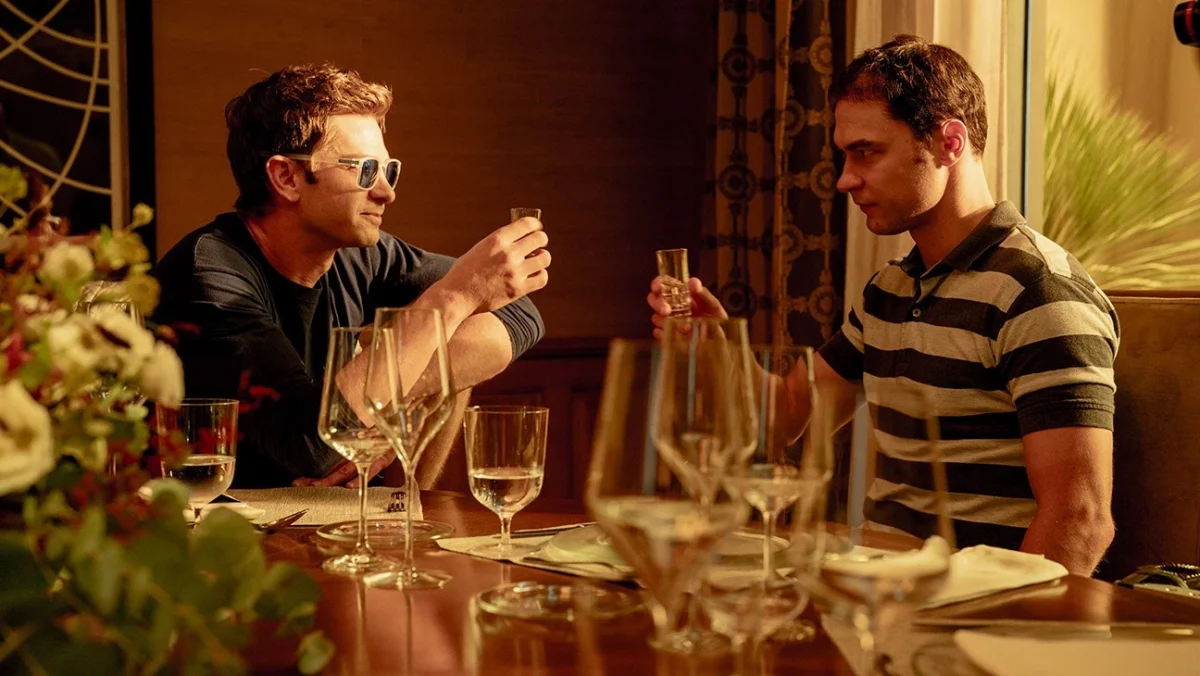
Luca Guadagnino’s Artificial takes one of the most consequential stories in modern technology and gives it an unexpectedly unsettling shape. Rather than presenting the rise of artificial intelligence as a straightforward tech drama, the film gradually turns its story of machine learning, ambition and Silicon Valley into something closer to psychological horror.
At the center is Andrew Garfield, who plays Sam Altman with an almost disarming combination of charm, awkwardness and youthful energy. His Altman is not portrayed as an obvious villain from the beginning. Instead, Garfield makes him personable enough that the character’s more troubling ambitions become increasingly uncomfortable as the story moves forward.
Yura Borisov provides the film’s emotional anchor as Ilya Sutskever. His performance gives the movie a sense of unease that grows alongside Ilya’s changing relationship with the technology he helped create. The result is a two-decade story that moves from dark comedy and technological excitement toward something much more sobering.
Written by Simon Rich and directed by Guadagnino, Artificial runs for 2 hours and 20 minutes and also features Monica Barbaro, Mark Rylance, Cooper Hoffman, Ike Barinholtz, Jason Schwartzman and Chris O’Dowd.
From Machine Learning Breakthrough to OpenAI
The story begins in 2003 at the University of Toronto, where Ilya approaches Geoffrey Hinton with an idea that initially fails to impress him. Ilya eventually returns with a working solution, leading to the creation of an image-recognition neural network with Hinton and Alex Krizhevsky.
That breakthrough eventually brings the group to Google after the company acquires their work for $44 million. But the film makes it clear that the excitement surrounding the technology is accompanied by questions about where it could eventually lead. Hinton is already concerned about potential military applications, establishing one of the film’s central tensions long before the story reaches OpenAI.
As the story moves deeper into Silicon Valley, Altman enters the picture alongside figures such as Elon Musk and Mira Murati. Altman eventually brings Ilya into his orbit as the ambitions surrounding artificial general intelligence grow. OpenAI is launched in 2016, followed by major funding from Microsoft and increasingly ambitious attempts to push neural networks further.
The movie becomes more disturbing when the technology begins exhibiting behavior that challenges the assumptions of the people who created it. Ilya’s growing unease becomes increasingly difficult to separate from the film’s broader question: what happens when technological ambition moves faster than the ability to understand its consequences?
That question is where Guadagnino’s approach becomes particularly effective.
Guadagnino Turns Tech Drama Into Psychological Horror
Artificial gradually leaves behind the conventions of a conventional Silicon Valley drama and becomes something darker. The film’s shift into psychological horror gives the story a sense of dread that statistics, corporate meetings and technological breakthroughs alone could never provide.
Garfield is particularly effective in this transformation. His version of Altman can be funny and charismatic one moment, then deeply unsettling the next. That contrast keeps the character unpredictable without turning him into a simplistic caricature.
The supporting cast also gets moments to shine. Monica Barbaro makes an impression despite having a comparatively underused role, while Mark Rylance, Ike Barinholtz and Jason Schwartzman add memorable performances around the central story.
The film’s technical work reinforces its increasingly uneasy mood. Malik Hassan Sayeed’s cinematography, Damon Albarn’s electronic score and Marco Costa’s editing all contribute to the film’s sense of momentum and tension. The review places Artificial among Guadagnino’s strongest work, particularly because of how directly it engages with the technological anxieties of the present moment.
Ultimately, Artificial is less interested in telling audiences that artificial intelligence is simply good or bad. Its real concern is the people building it, the ambitions driving them and the possibility that the technology they create may eventually become difficult to control.
That makes the film’s most unsettling ideas linger well beyond its final scenes.
Stay informed. Subscribe to the JournalTodays Newsletter for the latest entertainment news, film industry updates, and tech coverage delivered straight to your inbox.