
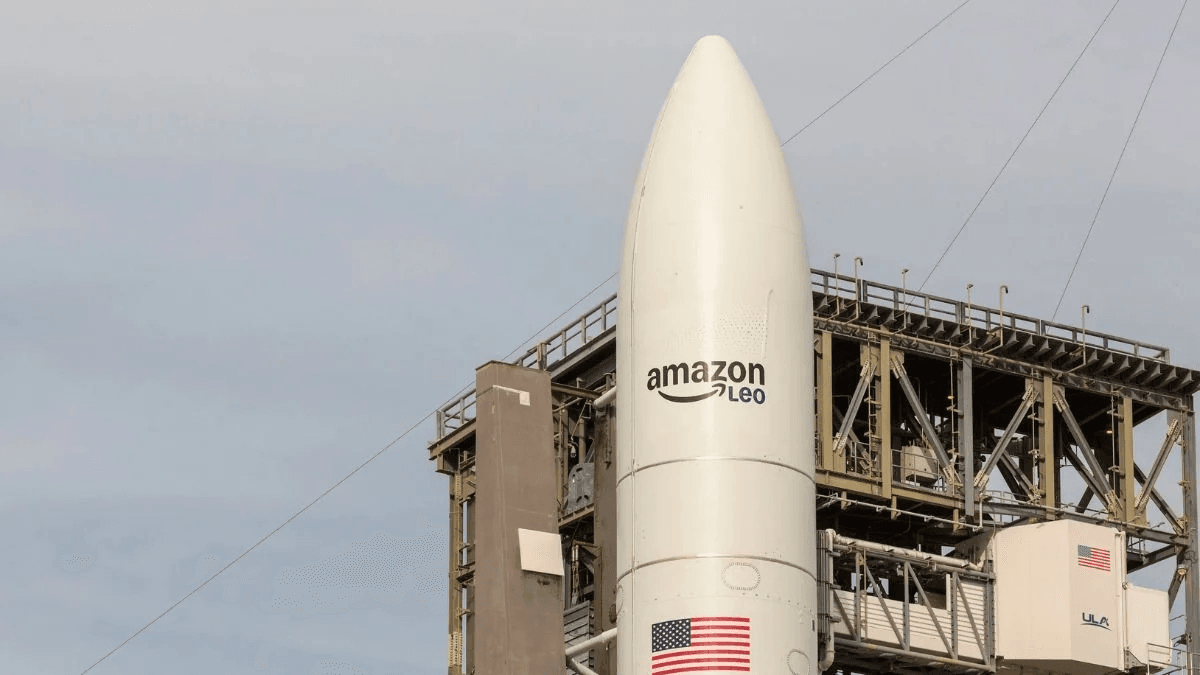
Amazon has made its boldest move yet in the race for space-based internet dominance. The tech giant has agreed to acquire satellite company Globalstar in an all-cash deal worth $11.57 billion — a major step toward challenging Elon Musk‘s Starlink, which currently sits comfortably at the top of the satellite connectivity market.
The acquisition, priced at $90 per share, hands Amazon full control of Globalstar’s satellite operations, infrastructure, and — critically — its mobile satellite services spectrum licences. It is a strategic power play designed to supercharge Amazon’s young satellite internet venture, Amazon Leo, ahead of its commercial launch later this year.
Why Globalstar? The Apple Connection
Globalstar is not a household name for most consumers, but its technology is already quietly embedded in hundreds of millions of pockets worldwide. The company is the power behind Apple’s Emergency SOS via satellite feature — the capability that allows iPhone 14 and later devices to send emergency messages, request roadside assistance, and share locations even when there is no cellular signal.
As part of the deal, Amazon confirmed it has struck a separate agreement with Apple to continue providing these satellite connectivity services for the iPhone and Apple Watch going forward. For Amazon, inheriting that relationship with one of the world’s most valuable companies is arguably just as significant as the satellites themselves.
Globalstar currently operates more than 24 satellites in low-Earth orbit and has agreements in place to acquire more than 50 additional new satellites. The company also has an existing arrangement with SpaceX to launch replacement satellites for its current constellation this year — an interesting dynamic given that SpaceX‘s Starlink is effectively Amazon’s primary competitor in this space.
Amazon Leo: Building the Challenger to Starlink
Amazon Leo is the company’s ambitious answer to Starlink’s dominance. The service is being built around a constellation of more than 3,200 satellites in low-Earth orbit, targeting both individual consumers and large enterprise customers.
Just days before the Globalstar announcement, Amazon CEO Andy Jassy highlighted an impressive early roster of customers already signed up for Amazon Leo — including Delta Airlines, AT&T, Vodafone, Australia’s National Broadband Network, and NASA. The company also unveiled a new satellite internet antenna designed specifically for commercial aircraft, promising high-speed in-flight connectivity.
The Globalstar acquisition accelerates Amazon Leo’s ambitions significantly by adding direct-to-device capabilities — the ability to connect smartphones and other devices directly to satellites without needing a traditional cellular tower. This technology is increasingly seen as the future of mobile connectivity, particularly in remote and underserved regions of the world.
Amazon has also signalled plans to deploy its own direct-to-device satellite system from 2028, which would integrate seamlessly with its existing broadband infrastructure. The long-term vision is a network of thousands of advanced satellites supporting “hundreds of millions of customer endpoints around the world.”
The Starlink Gap — And Why It Matters
Make no mistake — Amazon is playing catch-up. Starlink currently operates more than 10,000 satellites and offers internet services across roughly 150 countries, serving retail customers, businesses, maritime operations, and the aviation industry. It is a formidable lead.
Amazon Leo, by comparison, has so far launched only around 200 of its planned 3,200+ satellites and has already faced delays significant enough to require the company to seek an extension from the Federal Communications Commission on a deadline requiring approximately 1,600 satellites to be in orbit by July this year.
The Globalstar deal does not close that gap overnight. But it gives Amazon something it did not have before — an operational satellite network with real spectrum licences, existing customer relationships, and a proven direct-to-device technology in active use on millions of Apple devices today. That foundation could meaningfully compress Amazon’s timeline to becoming a credible competitor.
What This Means for the Satellite Internet Market
The battle for space-based connectivity is heating up faster than almost anyone anticipated. With Amazon now firmly committed to competing with Starlink, consumers and businesses around the world stand to benefit from increased competition — potentially driving down prices and expanding coverage to areas that have historically been left behind by traditional internet infrastructure.
For Apple users specifically, the deal brings continuity. Emergency SOS and related satellite features will continue to function as normal, now backed by Amazon’s considerably deeper pockets and infrastructure ambitions.
And for Elon Musk and Starlink, the arrival of a well-resourced Amazon as a direct competitor raises the stakes considerably — even if Starlink’s current lead remains substantial.
The space race for your smartphone signal has officially begun.