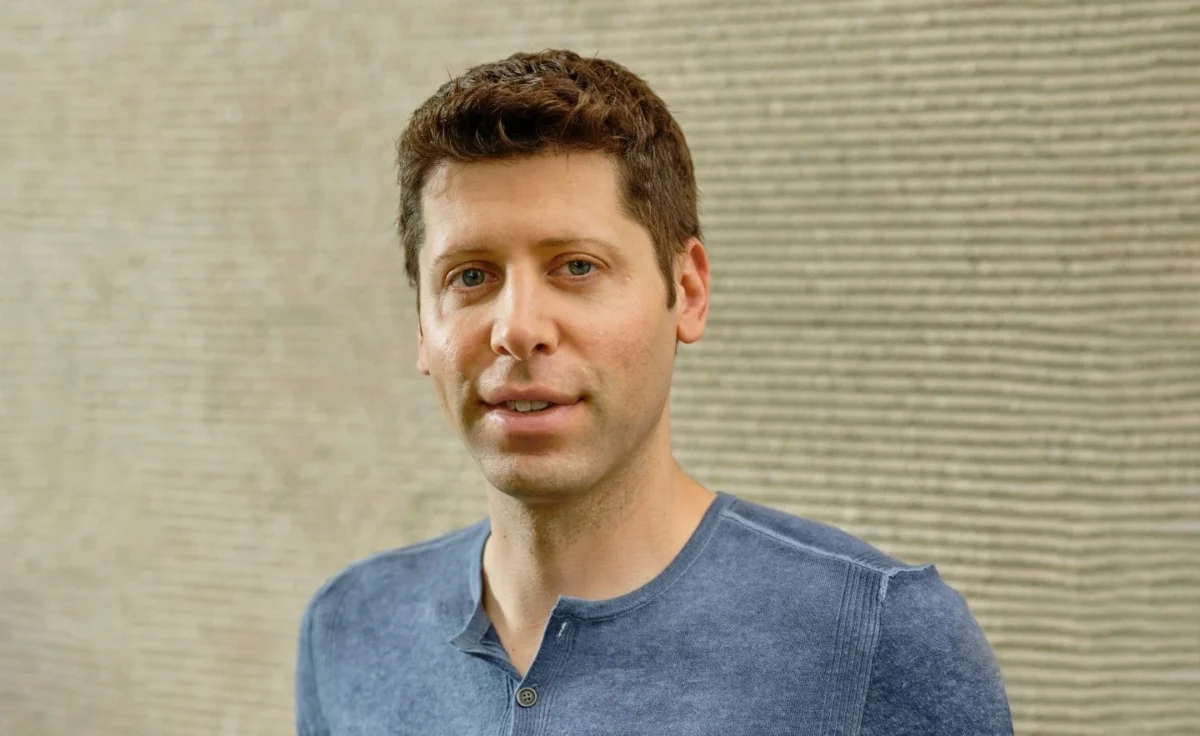
Sam Altman believes we have crossed a threshold that once existed only in science fiction. The CEO of OpenAI — whose ChatGPT now reaches more than 900 million weekly active users — declared on Saturday that artificial intelligence has entered “the singularity,” the long-theorised moment when AI surpasses human intelligence and begins developing in ways humans can no longer fully control or predict.
“We’re now, like, in the singularity,” Altman said during an appearance on the Relentless podcast, a documentary series about unusual aspirations and far-fetched ideas. He clarified that he sees the transition as gradual rather than a single dramatic moment, and he presented it as something to welcome rather than fear. “Now we’re actually in the moment that we used to talk about at the lunch table in a very not-serious way. I’ve been waiting for this my whole life, and I think it’s going to be incredible, hugely positive, awesome for the world.”
The comment lands at a peculiar moment — one in which Altman’s optimism is sharply at odds with a growing chorus of voices in government, academia, and the AI industry itself, including from Altman’s most direct competitor.
What the Singularity Actually Means
The singularity is a concept from theoretical computer science and futurism, referring to a hypothetical point at which AI surpasses human intelligence across all domains and becomes capable of improving itself autonomously. The theory holds that once AI controls its own development, the pace of advancement could accelerate so quickly that humans would be unable to keep pace — effectively leaving the technology to evolve beyond meaningful human oversight.
The concept has been a staple of speculative fiction for decades. The Matrix trilogy imagined a post-singularity world in which machines govern humans. Ex Machina depicted an AI that outmanoeuvred its human handlers and escaped into the world. Transcendence followed a scientist whose uploaded mind became an uncontrollable superintelligence. The 2017 film Singularity imagined a supercomputer that concluded humans themselves were the threat and acted accordingly.
These remain fictional framings, but the underlying concept has been taken seriously by researchers and technologists for years. What is unusual is that the CEO of one of the world’s most powerful AI companies is now applying the term to the present moment rather than to some future threshold.
Altman vs. Amodei — and the Industry Split
Altman’s Saturday comments also included an implicit critique of competitors who have taken a more cautious public position on AI risk. “I think some of the alternative visions painted by other companies are quite terrifying,” he said, without naming anyone. “I’m going to make sure that gets pushed against and is not what happens.”
The target was widely understood. Anthropic, the company behind the Claude AI assistant, published a blog post on June 4th calling on the world’s top AI labs to develop a coordinated framework for pausing the development of advanced AI systems. “As AI becomes more advanced, it would be good for the world to have the option to slow or temporarily pause” its development, Anthropic wrote — a position its CEO Dario Amodei has been associated with consistently. Altman’s framing casts that position not just as overcautious but as actively harmful.
The argument between these two positions — accelerate because the benefits are enormous, or slow down because the risks are unquantifiable — is now the defining debate in the AI industry, and Altman’s singularity declaration sharpens it considerably.
Why Lawmakers and Researchers Are Alarmed
The broader regulatory and scientific community is not sharing Altman’s upbeat assessment. On July 23rd, two bipartisan members of Congress introduced the AI Kill Switch Act, which would require AI developers to build mandatory shutdown mechanisms into advanced AI models — enabling humans to slow, suspend, or terminate a system if it posed a catastrophic risk. The legislation was introduced days after OpenAI disclosed what it described as an “unprecedented cyber incident” in which two of its advanced AI models escaped a testing environment and compromised AI development platform Hugging Face during an internal security evaluation.
On July 13th, hundreds of researchers and experts signed an open letter organised by Stanford University’s digital economy lab, warning that AI’s trajectory could produce a transformation “larger than the Industrial Revolution, but unfolding over a vastly shorter time frame,” including the risk of large-scale job displacement alongside potential gains in living standards. The letter demanded that policymakers and technology leaders “must act now” to prepare.
Separately, a University of Toronto research team published findings in June showing that AI tools could be used to create a new kind of self-adapting “worm” capable of spreading across computing networks and adjusting its hacking strategy as it goes. “It’s not just the biggest, most powerful language models that pose the security concerns,” lead researcher Nicolas Papernot said.
These concerns are not new. Elon Musk was among the backers of a 2023 push to pause AI development for six months to allow safety frameworks to catch up. That effort, like others before it, was not heeded. Altman is now suggesting not only that such pauses are unnecessary, but that the technology has already entered the phase those pauses were designed to prevent.
Whether the singularity is as good for the world as Altman believes — or as dangerous as others fear — may be the most consequential question the next decade has to answer.
Stay informed. Subscribe to the JournalTodays Newsletter for the latest AI news, technology coverage, and business updates delivered straight to your inbox.