

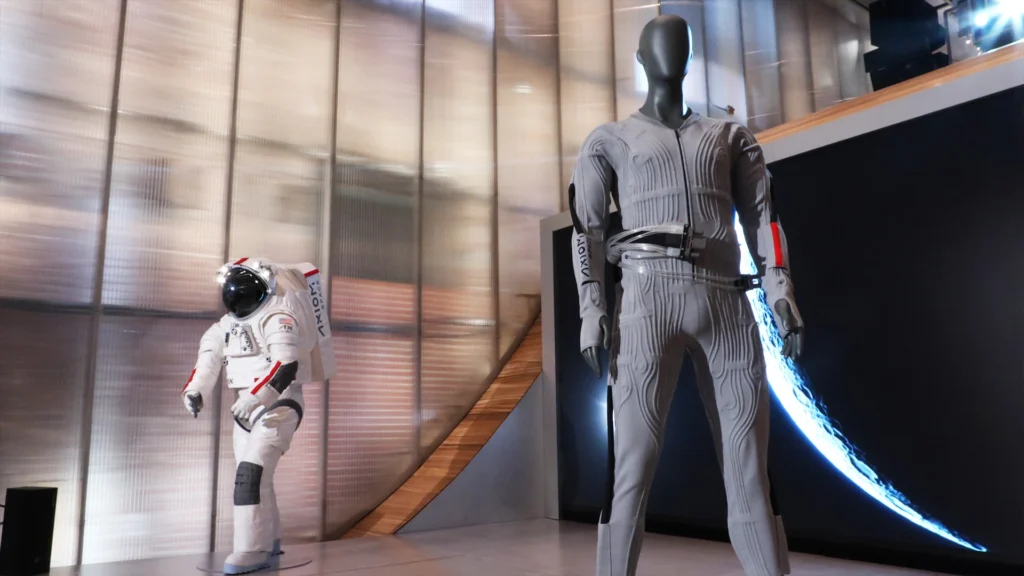
When NASA sends astronauts back to the moon, they will be wearing Prada. The Italian fashion house and aerospace company Axiom Space unveiled the Liquid Cooling and Ventilation Garment — the undersuit worn inside their AxEMU spacesuit — at a press event on Sunday June 7th. Complete with a v-neck, thumbhole sleeves, stirrup pants, Prada’s signature red stripe, and a network of technical tubing running through the fabric, it looks like premium activewear. It also has to keep a human being alive on the lunar surface.
“It’s not often that astrophysics and aeronautics develops things that are aesthetically pleasing,” Axiom Space CEO Jonathan Cirtain said at the event. “But while aesthetically pleasing, this is a safety suit. It’s a really remarkable piece of technology.”
The garment works through a network of built-in channels into which small tubes carrying cooling liquid are threaded, circulating temperature-controlled fluid around the body. This is a meaningful engineering improvement over previous designs, which required tubes to be manually threaded through mesh material — a slow, labour-intensive process. Larger tubes running through the suit carry air first over the astronaut’s face and then around their body, managing carbon dioxide as they exhale and delivering oxygen as they inhale.
ALSO READ: Google’s Gemma 4 12B Runs Entirely on Your Laptop and Processes Audio and Video Without the Cloud
Why the Moon’s South Pole Demands Something Better
The AxEMU and its LCVG undersuit are not simply updated versions of what came before — they represent a fundamental rethink driven by where NASA is going. The Artemis programme is targeting the lunar South Pole, a region no human has ever visited and one that presents environmental challenges the Apollo-era suits were never designed to handle.
The South Pole is not always in direct sunlight. The temperature swing between sunlit and shadowed areas can exceed 400 degrees Fahrenheit. “That’s a very complex environment, and so there’s a lot of interesting upgrades we’ve made to what’s been available in the past,” Cirtain said. The suit is also designed to offer potentially bespoke fits for individual astronauts — a significant departure from the one-size-fits-all approach of earlier programmes — and to use modular components that can be individually sized and swapped out rather than replacing an entire suit.
Prada’s contribution goes well beyond aesthetics. The fashion house provided the ballistic material covering the exterior of the suit — the layer responsible for maintaining structural integrity in the unique conditions of the lunar environment and preventing tears while the astronaut moves across the surface. Their expertise in high-performance materials, refined over decades of luxury manufacturing, translates directly into life-safety applications.
The partnership has a historical precedent. When NASA developed the Apollo spacesuits in the 1960s, it turned to ILC Dover — a small Delaware company connected to bra manufacturer Playtex — whose expert sewists and knowledge of nylon and flexible materials helped create a suit astronauts could actually move in. The principle is the same: technical garment expertise, wherever it comes from, matters enormously when the garment has to work in space.
The LCVG will be tested in NASA’s Neutral Buoyancy Laboratory — the enormous swimming pool where astronauts practice spacewalk procedures — and may also undergo testing on the International Space Station before the full AxEMU suit is used on an Artemis lunar surface mission.
Stay informed. Subscribe to the JournalTodays Newsletter for the latest space, technology, and science news delivered straight to your inbox.