

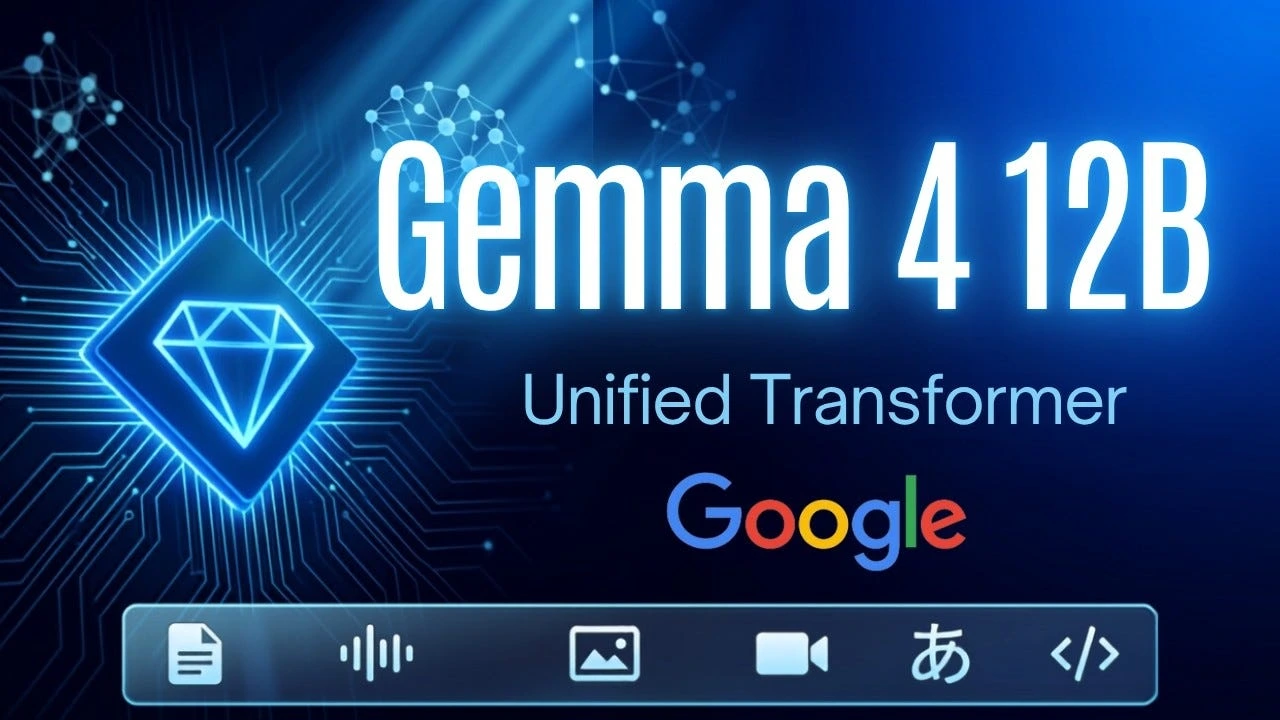
Google has released a new open-source AI model that runs entirely on a standard enterprise laptop — no cloud connection required, no recurring API costs, and no data leaving the device. Gemma 4 12B, an 11.95-billion-parameter model released Wednesday under a permissive Apache 2.0 licence, is available immediately for free download on Hugging Face and Kaggle, and is designed to operate on machines with just 16GB of VRAM or unified memory.
The model’s headline capability is something genuinely new in on-device AI — an encoder-free architecture that allows raw audio waveforms and video frames to flow directly into the core language model without the latency or memory overhead of traditional secondary processing modules. In practical terms, this means Gemma 4 12B can process text, images, and audio in a single unified system that fits comfortably on the kind of laptop most enterprise workers already carry.
What Makes the Architecture Different
Traditional multimodal AI systems use separate encoders to translate audio and visual data into formats the language model can understand. Each encoder adds latency and memory consumption. Gemma 4 12B eliminates that overhead entirely — the vision encoder is replaced by a 35-million-parameter module using a single matrix multiplication, and the audio encoder is removed altogether. Audio waveforms and visual patches are projected directly into the model’s core embedding space through lightweight linear layers.
For enterprise engineering teams, the practical consequences are significant. Lower latency for multimodal tasks. Reduced hardware requirements. The ability to fine-tune the entire multimodal system in a single pass rather than separately updating each component. And critically — the ability to run the whole thing on a 16GB laptop, which covers the vast majority of standard enterprise hardware already in circulation.
The model also packs a 256,000-token context window, which means it can process lengthy financial documents, extensive code repositories, or hour-long meeting transcripts in a single session. It includes a native step-by-step reasoning mode, out-of-the-box function calling for building autonomous agents, and support for industry-standard deployment frameworks including vLLM, SGLang, MLX, and llama.cpp.
Despite its compact size, Gemma 4 12B achieves benchmark performance approaching Google’s larger 26-billion-parameter Mixture-of-Experts model — a meaningful achievement given the gap in hardware requirements between the two.
ALSO READ: Nvidia Is About to Launch Its First Windows PCs — and It Could Change Everything About AI Computing
Who Should Actually Use It
The strongest use cases are specific and well-defined. Organisations in healthcare, finance, or defence that cannot legally or practically send sensitive data to third-party cloud APIs now have a capable multimodal model they can run entirely on premises. Teams building autonomous agents that need to process real-time audio or variable-resolution images have a reasoning engine that handles both without external dependencies. Edge deployments — retail inventory monitoring via cameras, offline field service applications, local customer service kiosks — now have access to frontier-class reasoning without persistent cloud connectivity or unpredictable billing.
The limitations are equally specific. Audio processing is hard-capped at 30 seconds. Video is limited to 60 seconds at one frame per second. For organisations needing to process feature-length media, chunking architectures or API-based models remain necessary. Gemma 4 12B is also a reasoning engine, not a database — use cases that rely primarily on vast factual retrieval without a Retrieval-Augmented Generation pipeline may still require larger foundation models.
For enterprise leaders looking to decentralise AI workloads, reduce cloud dependency, or process sensitive multimodal data without it ever leaving the building, Gemma 4 12B is worth serious evaluation.
Stay informed. Subscribe to the JournalTodays Newsletter for the latest AI, technology, and enterprise computing news delivered straight to your inbox.