
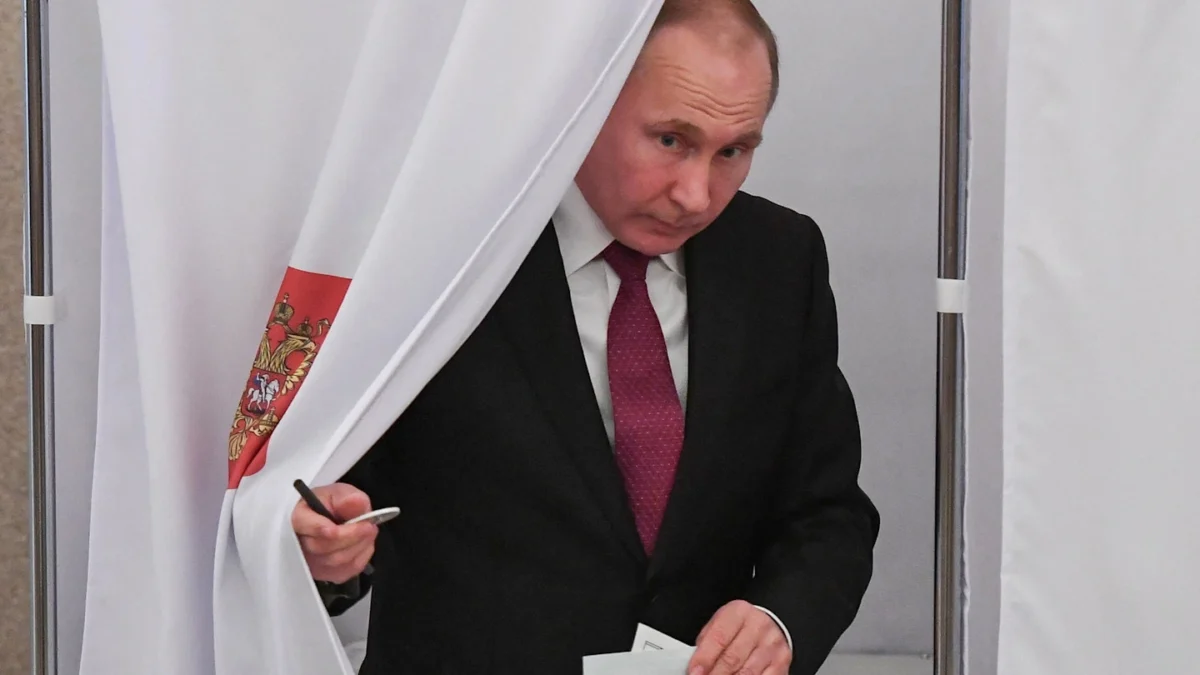
Vladimir Putin has further consolidated his grip on Russian political power following parliamentary elections in which his United Russia party secured a record 355 seats in the 450-seat State Duma — a super-majority exceeding even the party’s previous high-water mark of 343 seats set in 2016. The elections were the first held since Putin’s full-scale invasion of Ukraine in February 2022.
Forty-nine deputies who participated in the war against Ukraine are among those elected, with Kremlin officials initially claiming 86 veterans had won seats before revising the figure. United Russia received 57.83% of the vote with 95% of ballots counted, up sharply from the 49.8% it received in the 2021 election. Voter turnout stood just below 57%.
Putin’s spokesperson Dmitry Peskov said the result demonstrated “the highest level of consolidation within Russian society around the head of state.” Western governments condemned the elections as illegitimate.
A Contest Without Genuine Opposition
Russia’s supreme court banned Yabloko — the only party that opposes the war — from participating in the election before voting began. Anti-war candidates were broadly barred from the ballot. Those from Yabloko who had attempted to run said they feared for their freedom after two senior party figures were jailed before election day over comments about the war. Yabloko’s leader, Nikolai Rybakov, made a public point of spoiling his own ballot, writing his party’s name and the slogan “For peace.”
Russia’s elections chief Ella Pamfilova praised voters for resisting “psychological pressure” — a framing that drew international criticism. Local politician Boris Nadezhdin, who had previously attempted to stand in presidential elections on a peace platform, was barred from participating and accused of being a “foreign agent.”
The elections also included voting in four Ukrainian regions Russia illegally annexed in 2022 — Donetsk, Luhansk, Kherson, and Zaporizhzhia — as well as in Crimea, seized in 2014. The United Nations and the overwhelming majority of the world’s governments do not recognise any of those territories as Russian.
EU foreign policy chief Kaja Kallas called the result “another major setback for Russian democracy,” writing on X: “The Kremlin silenced dissent and shut out international election monitors. The veneer of democracy is all that remains.”
Who Else Won Seats — and What It Might Mean
The other parties that secured seats in the Duma all support the war in Ukraine. The Communist Party came second with approximately 13.8% of the vote and around 40 seats, followed by the ultranationalist LDPR with around 8.9% and 25 seats, New People with approximately 7.9% and 20 seats, and A Just Russia with just under 5%.
The Berlin-based think tank NEST, co-founded by Kremlin critic Mikhail Khodorkovsky, said votes for the Communist Party and New People may in many cases reflect silent dissatisfaction with United Russia rather than genuine ideological alignment. “The consequences of the war are increasingly being felt within the country, and accumulated anxiety and frustration may translate into votes for the systemic opposition parties that the Kremlin has allowed to remain on the ballot,” NEST wrote in an analysis. Final official results are expected by Friday.
Chechnya’s leader Ramzan Kadyrov, a close Putin ally, was re-elected with a reported vote share of more than 99%.
The War Context
The elections take place against a backdrop of escalating conflict. Russia has intensified its bombardment of Ukrainian cities in recent months, pummelling Kyiv and other population centres with jet-powered attack drones. On the final day of voting, Ukraine launched what Moscow called its largest-ever drone assault on the Russian capital, striking Moscow’s oil refinery and killing three people in the Moscow region and two in Russian-held Kherson — including one election official.
Overnight, Russia struck the southern Ukrainian city of Zaporizhzhia in what President Zelenskyy called a “brutal, targeted attack,” damaging a residential building, a university, a shopping centre, and a boiler house and injuring five people. A woman was killed in a separate drone strike in Kharkiv region.
Russia is also intensifying ground operations in Ukraine’s eastern Donbas region, pushing toward the cities of Kramatorsk and Sloviansk, though Ukrainian commanders report progress in a counteroffensive near Lyman. Speculation is mounting that Putin may announce a major new mobilisation campaign this autumn — Zelenskyy has suggested the Kremlin is seeking to recruit an additional 300,000 troops.
“Russia is not scaling back its escalatory actions and is signalling a readiness to expand the war,” Zelenskyy said.
Stay informed. Subscribe to the JournalTodays Newsletter for the latest Russia-Ukraine news, international affairs coverage, and current events updates delivered straight to your inbox.