
Global markets took a beating on Friday — and the reasons are piling up fast. Bond yields surged to levels not seen in decades, oil prices jumped sharply, and stocks slid across three continents, all driven by a combination of geopolitical deadlock, a largely empty diplomatic summit in Beijing, and no end in sight to the Iran war that has choked the world’s most critical oil shipping route since February.
The yield on the 30-year US Treasury bond rose above 5.12% on Friday — its highest level in nearly a year, and on track for its highest close since 2007. The 10-year Treasury note’s yield surged to nearly 4.56%, its highest since mid-May last year. US crude oil jumped more than 4% to over $105 per barrel, bringing its weekly gain to more than 9%. International Brent crude rose nearly 3.5% to over $109 per barrel — up 7% for the week. The S&P 500 slid 1%, the Nasdaq fell 1.3%, and the Dow Jones Industrial Average tumbled 430 points.
For ordinary Americans, the numbers translate directly into daily pain. The average price of unleaded petrol held above $4.50 per gallon on Friday morning — up 51% since the Iran war began. Spiking bond yields set the stage for higher borrowing costs on mortgages, car loans, and credit cards. The Consumer Price Index for April hit 3.8%, its highest level in three years. An index measuring wholesale prices reached 6% last month.
Beijing Delivered Promises — Not Results
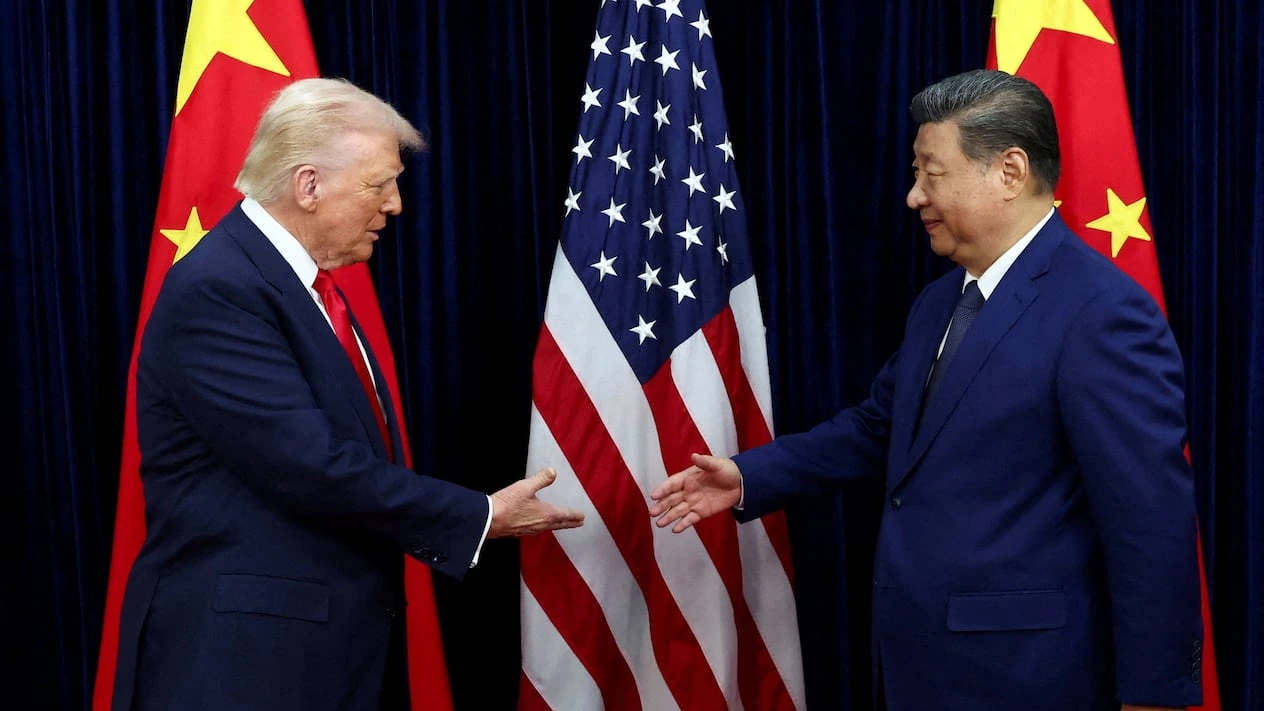
Markets had entered the week with cautious optimism about Trump’s summit with Chinese President Xi Jinping. That optimism evaporated quickly. When Nvidia CEO Jensen Huang joined the Beijing delegation at the last minute, investors took it as a signal that US chip export controls to China might be eased. Technology stocks rallied. Then the US Trade Representative confirmed on Thursday that chip export controls were not discussed at the Trump-Xi meeting. The rally reversed.
Tariffs — the central issue defining the US-China trade relationship — did not come up in the presidential meeting either, according to Trump himself. Administration officials mentioned the creation of a “board of trade” with China, but offered virtually no details. The status of the existing US-China trade truce, which lowered tariffs and eased some export controls, also remained unclear. The truce expires in November. Asked whether it would be extended, the Trade Representative offered only: “We’ll see about that.”
ALSO READ: Democrats Launch Investigation Into Trump Pardons — Did Recipients Pay to Get Free?
On the Boeing front — where Trump had floated the possibility of a deal for China to purchase hundreds of aircraft — the situation was equally murky. Trump described what sounded like an airline commitment to buy planes but struggled to characterise exactly what had been agreed. “I think it was a commitment,” he said. “Sort of like a statement, but I think it was a commitment.” Whether a formal deal between Boeing and a Chinese airline actually exists remained unclear at the close of Friday trading. Boeing’s order backlog already stretches to thousands of planes, meaning any Chinese delivery would likely take between five and ten years regardless.
The assessment from financial analysts was blunt. Markets had not heard enough from Beijing to turn more optimistic on the Persian Gulf situation — the root cause of the energy shock now rippling through the global economy.
The Strait of Hormuz Remains the World’s Most Expensive Bottleneck
Every market move on Friday traces back, in some way, to the Strait of Hormuz. The narrow waterway between Iran and Oman normally carries more than 20% of the world’s daily energy supply. Since the Iran war began on February 28th, transits through the strait have effectively stopped.
Oil prices have surged more than 80% this year as a result. European natural gas futures were up more than 4% on Friday alone — adding to a gain of more than 80% so far this year. The energy shock is feeding inflation across every major economy on the planet.
Trump reiterated on Friday that Iran’s most recent offer to end the war was “not enough.” He also confirmed that he did not ask Xi to use China’s significant leverage over Iran to push for a reopening of the strait. “I’m not asking for any favors, because when you ask for favors, you have to do favors in return,” Trump told reporters aboard Air Force One. “We don’t need favors.”
The practical consequence of that position is that the world’s most important oil shipping lane remains closed — with no timeline for resolution and no diplomatic pathway clearly visible.
The damage is global. In the UK, the yield on the 10-year government bond hit its highest level since 2008, with the 30-year gilt reaching levels not seen since 1998 — compounded by domestic political turmoil threatening Prime Minister Keir Starmer‘s hold on power. In Japan, heavily exposed to the Middle East energy shock, 10-year government bond yields hit their highest since 1999. German bund yields reached levels not seen since 2011. Europe’s Stoxx 600 fell 1.5%, with benchmark indexes in Germany and Italy sliding more than 2%.
The message from global bond markets is consistent and increasingly urgent: investors are losing confidence that the world’s largest economies have a plan to bring energy prices — and inflation — back under control.
Stay informed. Subscribe to the JournalTodays Newsletter for the latest global markets, finance, and geopolitical news delivered straight to your inbox.