
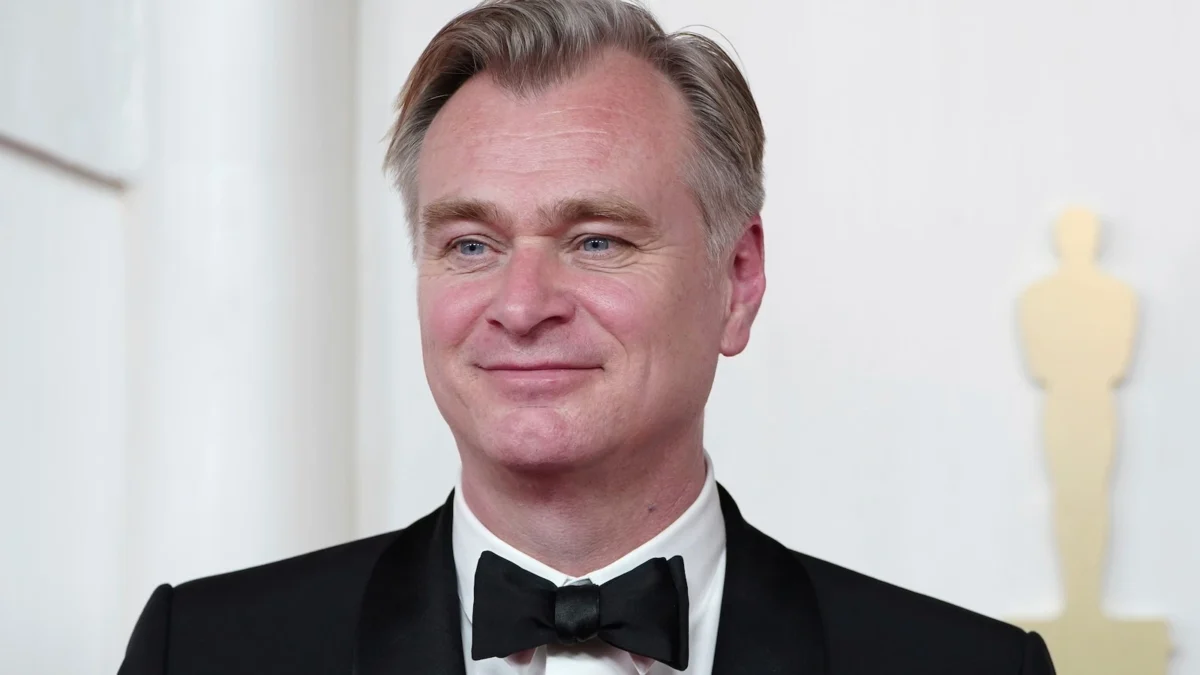
Christopher Nolan gave the most revealing interview of The Odyssey‘s press tour not to a major Western outlet but to a Chinese podcaster and political philosophy lecturer named Zhong Shu, on the Bilibili platform in Beijing. The conversation dispensed entirely with the usual press junket format — no favourite production anecdotes, no soft questions about casting — and went instead to Nolan’s personal philosophy, his views on civilisation, the Christian concepts embedded in an ancient Greek myth, and his frustration with a specific kind of modern film criticism. The interview has gone viral internationally, and for good reason.
Here are the key moments and what they tell us about the thinking behind Nolan’s soon-to-be billion-dollar adaptation.
“A Bard of a Civilisation at Dusk”
Zhong opened by framing Nolan as a modern Homer — a bard for his age — then pushing the analogy into uncomfortable territory. Homer’s poem celebrates war and victory, she noted. Nolan’s film does the opposite. Was he, therefore, a “bard of a civilisation at dusk?”
Nolan engaged the question seriously and at length. He noted the roughly 400-year gap between the events Homer was describing and when the poem was actually written down — a gap that changes the poem’s relationship to time and decline in ways modern readers tend to overlook. Homer’s audience, Nolan explained, viewed the Trojan War era as an advanced civilisation they were trying to recover rather than surpass. They were on a decline looking backward at greatness — and when they excavated the crumbled walls of ancient palaces, they assumed only giants could have built such structures.
“They had this idea of the greatness of this past civilisation,” Nolan said. “And so I became interested by that collapse, what they call the catastrophe, the Bronze Age collapse. What happens between the events of the Trojan War and Homer.”
He then connected this directly to his previous film. “I think it’s something that from a modern perspective is frightening and interesting, and I think for me it partly comes out of having worked on Oppenheimer before this, which is very much a film about the end of the world, about the collapse of civilisation, ultimately. So I definitely carried that sensibility into this adaptation.”
Did Nolan Christianise Homer?
Zhong raised what may be the interview’s most provocative question directly: the concept of atonement does not exist in ancient Greek culture, Greek language, or Homer’s poem. Had Nolan deliberately introduced a Christian framework into an explicitly pre-Christian text?
Nolan pushed back on the framing but acknowledged the underlying observation. He said his conscious focus was on xenia — the ancient Greek concept of mutual hospitality and respect, simplified in the film as “Zeus’s Law” — and the idea that the violation of this sacred law is what causes the central disaster of the story. The suitors in the palace are breaking Zeus’s Law, and in Nolan’s reading that is both the moral and structural engine of the narrative.
“I think the idea of atonement in a way is what we bring as viewers to the story,” he said. “I don’t know whether there really is atonement in the film, or whether we just feel that catharsis or that’s the process we’re seeing in the final meeting between Odysseus and Penelope. But I think we maybe bringing our more modern sensibility to that. Insofar as it’s there, it’s not a deliberate attempt to Christianise it, but it’s an outgrowth — a natural conclusion of burrowing in on this philosophical idea of what happens when you break Zeus’s Law.”
The distinction Nolan is drawing is subtle but important: the emotional experience of atonement may be present in the film, but it arrives through the ancient framework of xenia rather than through any conscious Christian import. The audience brings the modern resonance. The story provides the mechanism.
On Film Critics, Tropes, and the Language of Cinema
The interview’s third major strand concerned storytelling itself — and Nolan’s measured but pointed frustration with a particular failure mode in contemporary criticism. Zhong asked whether Nolan’s adaptation had to “apologise” for Homer’s celebration of greatness in order to suit modern democratic sensibilities.
Nolan’s answer reframed the question as one about mechanism versus validity. He argued that one of the core flaws in current film criticism — specifically what he called “amateur” criticism — is the belief that identifying how a story works on you constitutes proof that it didn’t work. “That’s a fundamental flaw of film criticism,” he said. “To be able to identify the mechanism does not invalidate the mechanism.”
He described the common criticism of making characters sympathetic as exactly this kind of fallacy: dismissing a narrative technique because the technique is visible. The storyteller’s job, he argued, is to be aware of the energy an audience brings and to work with it rather than against it. Whether a heroic figure requires qualification to be accepted by a modern audience is itself part of the mechanism — and the fact that the mechanism is identifiable doesn’t mean it shouldn’t be used.
Nolan clarified that his critique was aimed at amateur rather than professional criticism. “Professional film criticism tends to understand the necessity for the mechanisms,” he said. He described Hollywood storytelling as having developed a kind of universal language over the past century — a lingua franca with conventions that can be bent and broken but never ignored entirely. Filmmakers, he said, play with that language rather than in spite of it.
He illustrated the point with Memento. The film’s reverse chronology is unconventional on the surface, but underneath it Nolan retained a clear and simple three-act structure. “I needed this to be extremely familiar underneath so that I could change what’s on the surface. That’s one example where you make the choice: keep the deep structure conventional so you can innovate at the surface level.”
The interview as a whole offered something unusually rare from Nolan — a direct window into the intellectual architecture beneath the spectacle.
Stay informed. Subscribe to the JournalTodays Newsletter for the latest film news, Christopher Nolan coverage, and entertainment updates delivered straight to your inbox.