
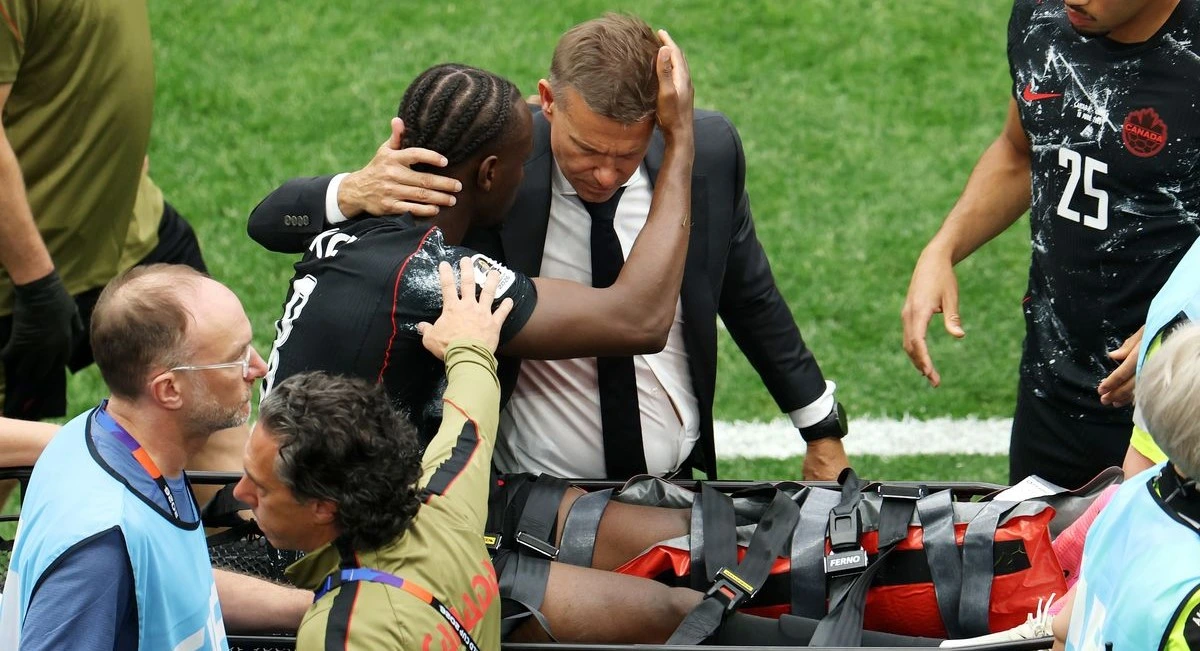
Canada’s first-ever World Cup victory was overshadowed by a horrifying scene in the second half. Midfielder Ismael Kone suffered a broken leg on a reckless tackle from behind by Qatar’s Assim Madibo, leaving the 24-year-old stretchered off BC Place to a standing ovation as Canada went on to secure a 6-0 win and top spot in Group B.
The tackle came early in the second half. Madibo went in from behind on Kone, and the reaction from everyone on the pitch made clear immediately how serious the injury was. Canada captain Stephen Eustáquio was among the first players to reach him. “I saw his leg. I saw that something wasn’t right,” Eustáquio said.
Coach Jesse Marsch did not need a medical report to know what had happened. “It happened right in front of the bench. We could all hear it,” he told reporters. “I knew right away it was similar to when Tajon Buchanan got hurt in training in 2024.” In a separate comment, Marsch said simply: “I could hear the bone snap.”
The Red Card and the Aftermath
The tackle initially drew only a foul call, prompting visible fury from the Canadian bench — Marsch and his staff could be heard on the broadcast incredulously questioning the referee, and several players physically pushed back against Qatar’s players in the immediate aftermath. A VAR review upgraded the call to a straight red card for Madibo, Qatar’s second dismissal of the match after Homam Al Amin was sent off in the 31st minute for a separate incident. Qatar finished the match with nine men.
Madibo’s own reaction suggested he understood the severity of what had happened. He put his hands over his head and waved them in apparent apology in the moments after the tackle. According to Marsch, that apology continued well beyond the pitch — Madibo came into the Canadian dressing room after the match and personally apologised to Kone, who relayed the gesture to his teammates.
Despite that, tensions boiled over again at the final whistle. An altercation broke out between the two benches, and a heated exchange took place between Marsch and Qatar coach Julen Lopetegui during the post-match handshake. Marsch declined to detail what was said but did not hide his frustration with how Qatar’s bench reacted in the moments immediately following the injury. “I don’t understand the reaction from their entire bench to try to start a fight about it being a red card when a clear foul just happened that broke a player’s leg. So strange behaviour, but in the end we were more focused on Ismaël.”
Canada striker Jonathan David, who scored a hat trick on the day, was blunt about the tackle itself. “If there’s a play where you cannot win the ball, there’s no point,” he said. “It’s just to hurt people.”
ALSO READ: Lionel Messi Scores a Hat Trick to Tie the Men’s World Cup Goal Scoring Record at Nearly Age 39
Kone’s Moment With the Crowd — and the Tribute That Followed
After trainers fitted an air cast to his left leg, Kone was wheeled off on a stretcher and waved to the Vancouver crowd, which had been chanting his name. Marsch described the moment as a window into who Kone is as a person. “He was waving to the crowd and almost making everybody else feel at ease with the fact that he’s injured, and it’s an incredible statement about Ismaël as a person, but this is our team,” Marsch said. “I’ve been trying to tell people for two years about the special character of this group and it gets highlighted in moments of challenging moments and in moments of glory.”
Nathan Saliba replaced Kone in the 56th minute. Eight minutes later, he scored Canada’s fourth goal from a free kick, ran straight to the bench, and was handed a Kone number 8 jersey — which he held up to the crowd as they cheered. It was the kind of moment that summed up the day: a team determined to finish what their injured teammate had started.
“Everybody was crushed when it happened, but we had to find a way to stay focused,” Marsch said. “We knew that Ismaël wanted us to finish the job.” Eustáquio echoed that sentiment when asked about the loss. “We’re going to miss him. He has that X factor that our team really needs.”
Kone’s Path to the World Cup — and What Comes Next
Kone is at the hospital and set to undergo surgery, with his mother and family by his side. Marsch said he planned to visit him personally after the post-match press conference. “Ismael is such a great kid, he’s imperfect but that is why we love him,” Marsch said. “He can do things that no other player can do. He embodies a lot of what this team is. He was our best player against Bosnia. He is a huge loss for us. Our hearts are with him, but that kid has a huge future.”
Kone was born in Ivory Coast and moved to Montreal at age seven. He came through the CF Montreal academy, made his MLS debut in 2021, and quickly drew attention from European clubs — joining Watford in 2022 before a £15 million ($20 million) move to Marseille in 2024. After a difficult half-season in France, he joined fellow Ligue 1 club Rennes on loan before moving to Italian side Sassuolo, with that loan made permanent in February. This was his second World Cup, having made his tournament debut in 2022 just months after his senior international debut.
Kone turned 24 just two days before the injury, celebrating his birthday on Tuesday June 16th. Under World Cup rules, Canada cannot replace him on the roster. Outfield player replacements must be made no later than 24 hours before a team’s first match — a deadline that has long since passed. Only goalkeepers can be substituted onto a World Cup roster at any point during the tournament.
Canada’s 6-0 win secured the team’s first-ever World Cup victory and top spot in Group B — a historic result for the host nation, delivered with one of its most important players watching from a hospital bed.
Stay informed. Subscribe to the JournalTodays Newsletter for the latest FIFA World Cup news, football coverage, and sports updates delivered straight to your inbox.