
Wednesday was one of the busiest days of Donald Trump‘s presidency in months — and none of it was simple. The president signed a $70 billion immigration enforcement bill into law, announced new US military strikes against Iran, revealed that American forces have been secretly ferrying oil through the Strait of Hormuz, declared that inflation numbers he called “great” at 4.2% were in fact the highest in three years, and suggested he has no intention of renewing the trade deal governing commerce with Canada and Mexico. All of this happened before noon.
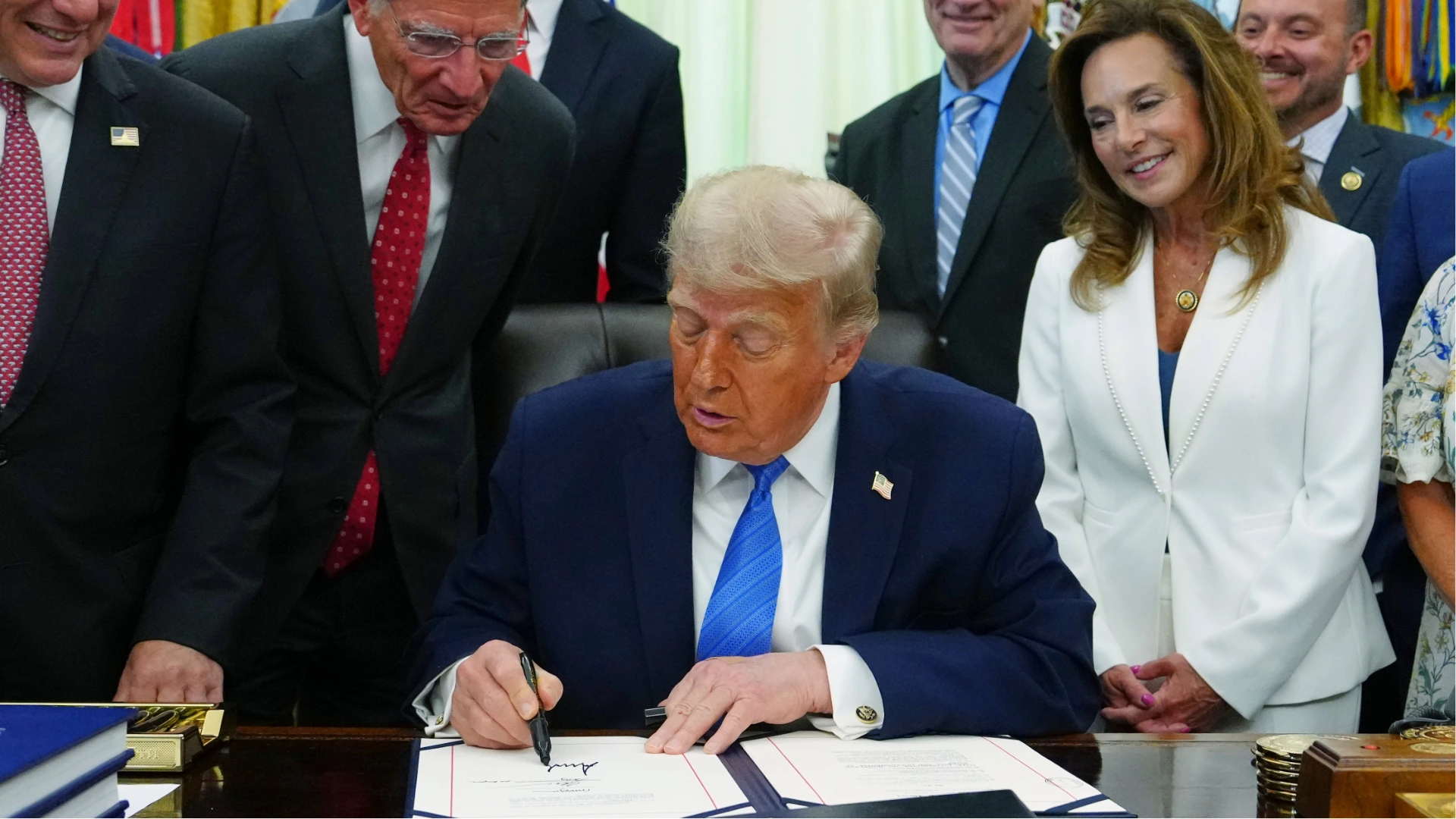
The immigration bill — passed by House Republicans in a 214-212 vote the previous day over unanimous Democratic opposition — provides $38 billion for Immigration and Customs Enforcement, $26 billion for Border Patrol, and $5 billion in reserve funding for unforeseen costs. Trump signed the legislation in the Oval Office surrounded by Republican lawmakers including Senator Rand Paul of Kentucky, who chairs the Senate Homeland Security Committee. The bill ends a six-month standoff over Department of Homeland Security funding that began with the shooting deaths of two US citizens during federal immigration operations in Minneapolis in January.
Iran, Oil and a Secret Night Operation
The Iran dimension of Wednesday was the most explosive. After a US helicopter was brought down by an Iranian drone, Trump announced new American strikes, telling reporters: “We’re going to hit them again hard today.” He also confirmed that US airstrikes had targeted Iranian air defense systems, ground control stations, and radar sites near the Strait of Hormuz, and revealed that a Palau-flagged vessel attempting to transport Iranian oil had been disabled by a US precision strike on its engine room.
Then Trump disclosed something he said he had been wanting to share for some time — that US forces have been secretly moving oil out of the Strait of Hormuz for months. “We’ve been taking out millions of barrels of oil,” he told reporters. “Nobody knows it. You know who doesn’t know about it? Iran. Until right now.” He described a night operation involving 22 ships with no lights. The disclosure’s strategic timing was unclear.
Iran, meanwhile, said US strikes had damaged two water reservoirs in the city of Sirik near the eastern end of the strait, cutting water supplies to thousands of residents. US Central Command did not immediately confirm or deny those claims. Earlier on Wednesday, Trump had posted that Iran was “taking too long to negotiate a deal” and would “have to pay the price,” without elaborating.
ALSO READ: Israeli Strike Kills Three Lebanese Soldiers Including a General Just Days After Ceasefire Deal
Inflation at 4.2% — and a President Who Says He Loves It
The latest Consumer Price Index report showed annual inflation at 4.2% — the highest level since April 2023 and well above the Federal Reserve’s 2% target. Trump called the numbers “great” and expressed genuine enthusiasm. He attributed the elevated inflation primarily to energy costs caused by the Iran war, suggesting prices would ease “as soon as this war is over.”
Economists and financial markets are less optimistic. Inflation has worsened consistently under Trump’s presidency, driven first by last year’s tariffs and now by the disruption to oil and gas shipments through the Strait of Hormuz. Prices have risen faster than wages for several months, consumers are dipping into savings and falling behind on credit card payments, and major retailers report changes in purchasing behaviour. New Federal Reserve chair Kevin Warsh — who replaced Jerome Powell earlier this year — holds his first policy meeting next week. Markets now expect the Fed could raise interest rates by year end rather than cut them, which would make mortgages, car loans, and business borrowing significantly more expensive.
Trade, FISA and the Maine Senate Race
Trump told reporters he has no interest in renewing the United States-Mexico-Canada Agreement, the trade deal he originally negotiated to replace NAFTA. The agreement faces annual reviews of its status without a renewal commitment by July 1st and could expire in 2036. “We don’t need their cars. We don’t need their lumber. We don’t need their energy. We don’t need anything that they have,” he said of Canada and Mexico.
On national security, Trump asked Congress for a short-term extension of Section 702 of the Foreign Intelligence Surveillance Act, which expires Friday. Democrats are resisting, citing Trump’s surprise appointment of Bill Pulte as acting director of national intelligence. Pulte, who simultaneously leads the Federal Housing Finance Agency, has no apparent national security background. Democrats are refusing to extend surveillance authorities while Pulte holds the post.
In politics, Maine Democrat Graham Platner secured his party’s Senate nomination to challenge Republican Senator Susan Collins — setting up one of the most consequential Senate races of the 2026 cycle. Trump endorsed Collins, saying she is “a sane woman,” while using some of his least restrained language to describe Platner in a press availability that drew uncomfortable laughter from Republican lawmakers in the Oval Office.
The United Nations human rights chief added another dimension to the World Cup week, urging the United States to rethink immigration enforcement practices after Iranian players were moved to a training camp in Mexico, an African referee was denied entry at Miami, and fans who had spent thousands on tickets and travel had their visas denied or revoked. The UN official called for “a dignified and safe environment for the teams that compete, but also for the supporters, for the whole society and frankly for the world.”
Stay informed. Subscribe to the JournalTodays Newsletter for the latest US politics, Iran war coverage, and breaking news delivered straight to your inbox.