
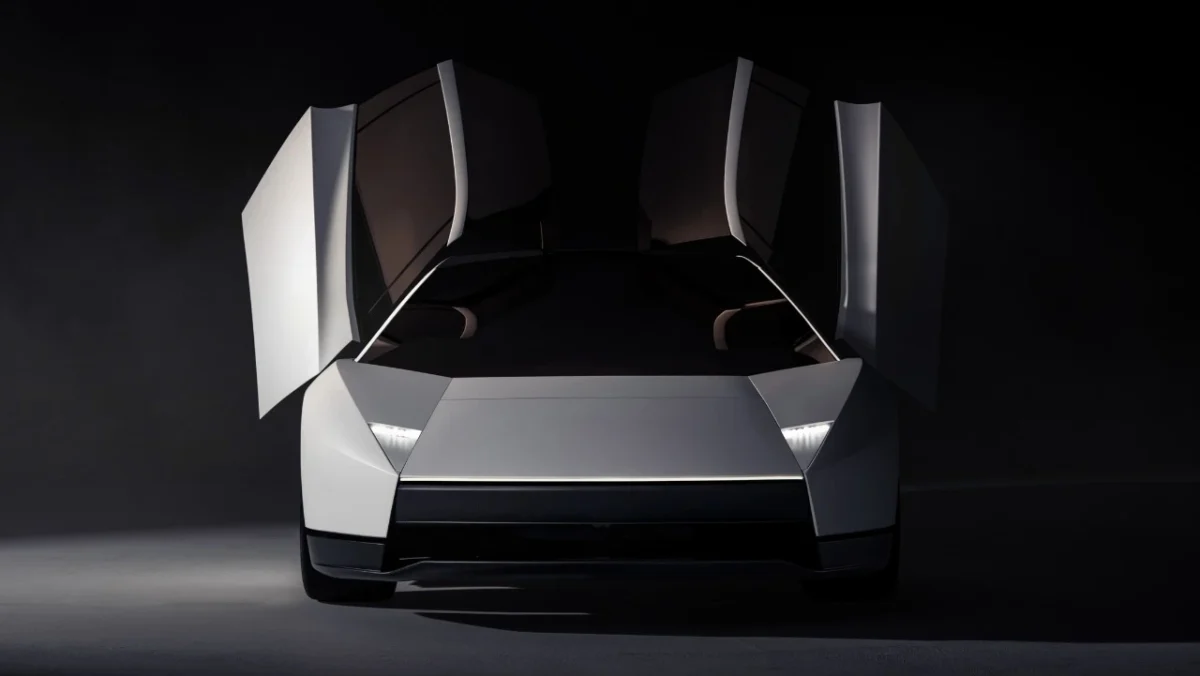
Tesla has finally unveiled its redesigned Roadster — more than a decade after first teasing a next-generation version — and it comes equipped with rocket-style thrusters developed in collaboration with SpaceX. The car drove upside down on a ramp, turned in the air, and landed using its built-in thruster system at a dramatic event held at SpaceX’s McGregor, Texas test facility Thursday night. Production begins in 2028.
The white two-seater also jumped over a truck and other vehicles during the reveal, using the thrusters to twist mid-air before landing — a spectacle that drew immediate comparisons to a film stunt. “That was the most insane product demo I’ve ever seen,” Tesla investor Sawyer Merritt posted on X. “I just saw this in person, and I’m still asking how this wasn’t AI.”
Tesla vehicle engineering chief Lars Moravy said the Roadster can accelerate from zero to 60 mph in under one second and hit a top speed of over 230 mph. CEO Elon Musk suggested the true ceiling was higher still: “I think you’ve got to crack halfway to the speed of sound.” The car offers a claimed range of over 300 miles on a single charge — less than half the 600-plus miles Musk promised in 2017, when Tesla first revealed the second-generation prototype and said deliveries would begin in 2020. That deadline was the first of many that passed without the car appearing.
The Versions and the Prices
Tesla’s reservation page following Thursday’s event listed three variants. A “Performance” version requires a $50,000 deposit. A “Thrust” version with the acceleration thruster system requires a $250,000 deposit. A “Rocket” variant — described as a single-seat model with a “full flight system” — is listed as invite-only. No full pricing was announced at the event, though Tesla quoted a base price of $200,000 for the vehicle nearly a decade ago.
Tesla shares rose 5% in premarket trading on Friday.
What the Car Actually Means for Tesla
The Roadster’s commercial significance to Tesla’s bottom line is limited by design. Musk called it a “small potato situation” in 2023 and was clear it would not “move the needle in a major way financially.” Morningstar analyst Seth Goldstein characterised it as a “halo car” — the kind of flagship engineering showcase intended to demonstrate capability rather than generate volume — noting that Tesla has lacked such a vehicle in its current lineup.
“It was an engineering flex with no commercial value beyond embarrassing traditional car makers,” said Gene Munster, managing partner at Deepwater Asset Management. More intriguingly, Munster suggested the SpaceX collaboration reflected Musk’s ongoing interest in a potential merger of his two largest companies: “The Roadster event is the latest example of why Elon can’t wait to bring Tesla and SpaceX together.”
Some market observers agree the Tesla-SpaceX engineering relationship — and the spectacle used to display it — reads as deliberate groundwork for consolidation, though Musk has not formalised any such plans publicly.
The reveal arrives as Tesla continues its pivot away from conventional car manufacturing toward autonomous driving and robotics. The company stopped selling its Model S and X this year to redirect production capacity toward its Optimus humanoid robot programme. Its Cybercab robotaxi — a two-seater without a steering wheel, pedals, or mirrors — has also launched. Third-quarter financial results are due October 21st and analysts say those numbers will carry significantly more weight with investors than anything displayed in Texas.
A Brief History of the Roadster’s Delays
The original Roadster, sold from 2008 to 2012 and built on a Lotus Elise chassis, was Tesla’s first vehicle and helped reshape public perception of what an electric car could be. The second-generation version was first revealed as a prototype in 2017 with a promised 2020 delivery date. That date passed. Then 2021. Then 2022. The 2028 production start now represents an eleven-year delay from initial announcement to first delivery — a gap the company has not publicly acknowledged as a failure, instead framing each updated timeline as a reflection of evolving ambition.
Stay informed. Subscribe to the JournalTodays Newsletter for the latest Tesla news, electric vehicle coverage, and technology updates delivered straight to your inbox.