
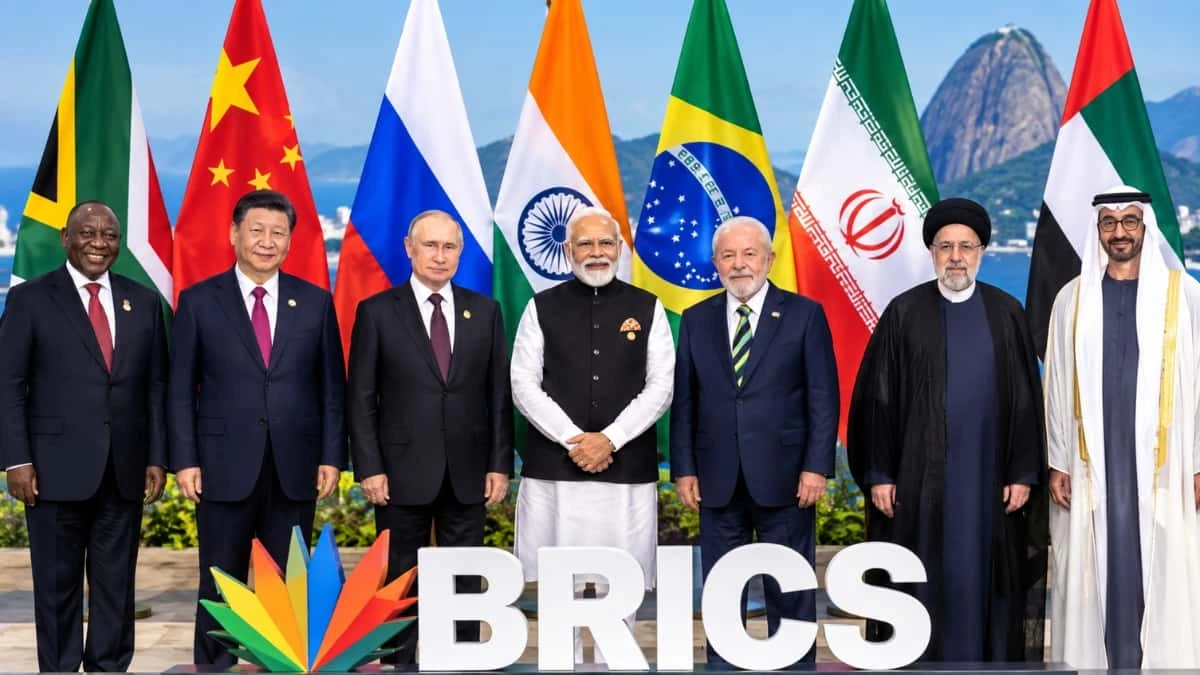
The BRICS bloc has adopted a unanimous joint declaration at its annual summit in New Delhi, calling for “maximum restraint” in the Middle East, warning against attacks on civilian infrastructure and nuclear facilities, and committing to defend the free flow of global trade, supply chains, and energy against what member nations describe as unlawful unilateral tariffs.
Indian Prime Minister Narendra Modi is hosting the two-day summit, which began Saturday. Chinese President Xi Jinping, Russian President Vladimir Putin, Iranian President Masoud Pezeshkian, South Africa’s Cyril Ramaphosa, Egypt’s Abdel Fattah el-Sisi, Ethiopia’s Abiy Ahmed, and Indonesia’s Prabowo Subianto are among those attending. The UAE sent Crown Prince of Abu Dhabi Sheikh Khaled bin Mohamed bin Zayed Al Nahyan as its representative. Brazil — a founding member — sent Foreign Minister Mauro Vieira in place of President Lula da Silva. The heads of the World Health Organization, the World Trade Organization, and UN Secretary-General António Guterres are also present.
The summit passes the BRICS presidency to India at a particularly turbulent moment. Wars in the Middle East and Ukraine are disrupting energy markets and global shipping routes. US tariffs are squeezing multiple BRICS members. And the bloc itself is internally divided over how to respond to both crises.
What the Declaration Says
The joint declaration expressed “deep concern over the continued escalation of tensions” across the Middle East and called for all parties to exercise “maximum restraint.” It specifically warned against deliberate attacks on civilian infrastructure and nuclear facilities.
On Palestine, the declaration reiterated BRICS’s firm opposition to forced displacement and any changes to the geography or demography of occupied territory. It called for an end to Israeli violence in Gaza, support for UNRWA, and full United Nations membership for Palestine.
The declaration also covered economic architecture — calling for the expansion of non-Western cross-border payment channels, cooperation on artificial intelligence, and an explicit rejection of unilateral sanctions and tariffs that member nations say distort trade and violate WTO rules. BRICS finance ministers and central bank governors have objected to such measures in recent months, and the declaration makes the bloc’s collective position official.
The Bilateral Meetings That Shaped the Summit
Xi Jinping arrived in New Delhi on Saturday morning — his first visit to India in seven years. The trip reflects the ongoing warming of India-China relations after years of tension following a 2020 border clash. On the Middle East, Xi was direct: the war there “does not serve the common interests of the international community,” he said, adding that it had “caused serious losses to people across the region.”
On Friday, ahead of the formal summit opening, Modi held talks with Putin — the two leaders agreed to deepen bilateral ties. Modi also met separately with Pezeshkian, with discussions focused on freedom of navigation and the safety of ship crews in the Strait of Hormuz, which has been disrupted by the ongoing US-Israel war on Iran. Egypt’s el-Sisi, speaking at a closed session, called for “the stability and freedom of international navigation,” warning that Middle East instability had “negative repercussions on the global economy, trade and energy flows, and supply chains.”
The Tensions Beneath the Consensus
The unanimous declaration papers over some significant internal fault lines. Iran and the UAE — both BRICS members — are on opposing sides of the war the United States and Israel launched against Iran. A BRICS foreign ministers’ meeting in May this year ended without a joint statement on the conflict, illustrating how difficult consensus on the war has been within the bloc.
Last year’s summit produced a joint statement condemning the initial US-Israeli bombing campaign against Iran’s leadership and nuclear programme. The New Delhi declaration represents a continuation of that position, though its language on “restraint” and civilian protection is carefully worded to avoid drawing lines that some members would not cross.
The bloc’s relationship with the United States has also grown more openly confrontational. President Trump has described BRICS as “anti-American” and threatened punitive tariffs on countries that align with it. BRICS represents 11 member nations and a significant portion of global economic activity, making the tension between the bloc and Washington one of the defining dynamics of the current international order.
BRICS — originally standing for Brazil, Russia, India, China, and South Africa — was founded in 2006 as a forum for major emerging economies seeking greater influence in institutions dominated by Western powers. Subsequent expansion rounds have added Iran, the UAE, Egypt, Ethiopia, Indonesia, and others.
Stay informed. Subscribe to the JournalTodays Newsletter for the latest BRICS news, geopolitics coverage, and international affairs updates delivered straight to your inbox.