
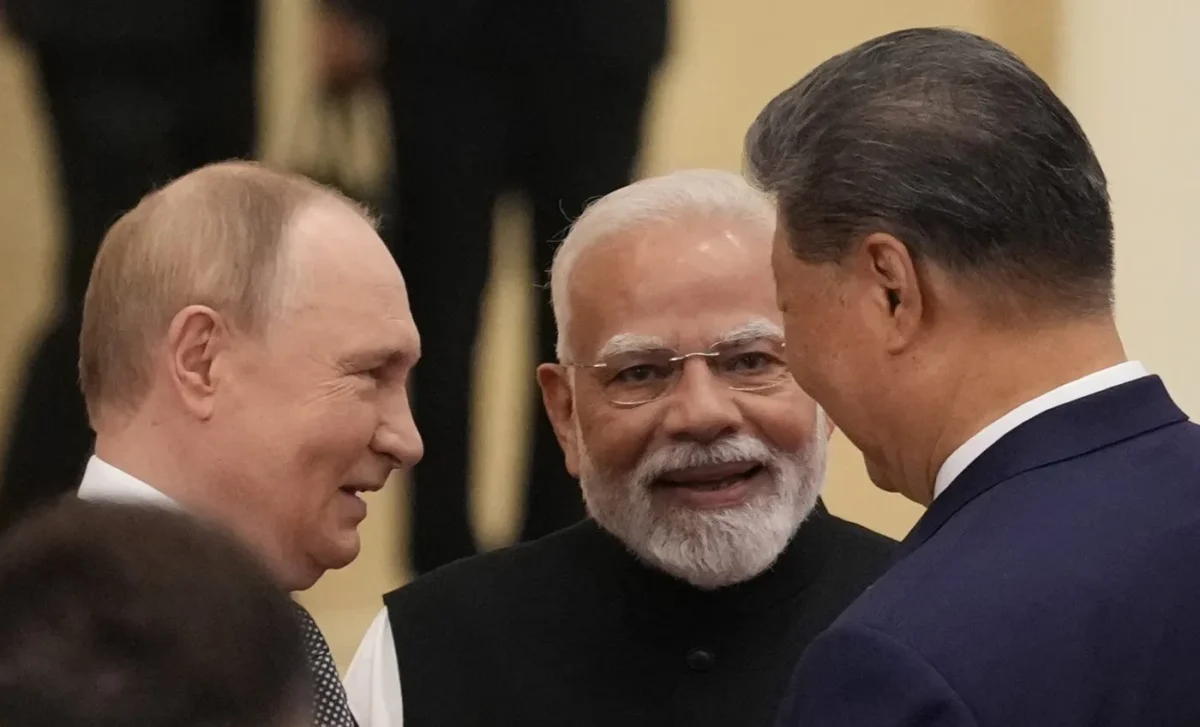
Chinese President Xi Jinping, Russian President Vladimir Putin, Indian Prime Minister Narendra Modi, and Iranian President Masoud Pezeshkian are among the leaders gathering in Bishkek, Kyrgyzstan, for the annual Shanghai Cooperation Organisation summit — a two-day meeting that arrives at one of the most geopolitically charged moments in the bloc’s 25-year history.
The summit — held under the motto “Together for Sustainable Peace, Development and Prosperity” — is taking place as the world grapples with the ongoing US-Israel war on Iran, the Russia-Ukraine war now in its fifth year, and the continued disruption of global supply chains and energy markets. Turkish President Recep Tayyip Erdoğan, UN Secretary-General António Guterres, and ASEAN Secretary-General Kao Kim Hourn are also in attendance.
Xi and Putin have already met on the sidelines. A Putin-Erdoğan bilateral on Ukraine is also expected, alongside Modi-Putin talks that are likely to touch on trade routes, energy, and the warming India-China relationship.
What the SCO Is and Why It Matters This Year
The SCO began in 1996 as the “Shanghai Five” — a security bloc formed by China, Russia, Kazakhstan, Kyrgyzstan, and Tajikistan to settle border disputes following the Soviet Union’s collapse. It evolved into its current form in 2001, expanding over subsequent years to include Uzbekistan, then India and Pakistan in 2017, and more recently Iran and Belarus as full members. Today it encompasses 43% of the world’s population and approximately 23% of global economic output.
Its 25th anniversary summit is considered particularly significant. Analysts say it represents the first opportunity to translate the “Tianjin Strategy” — adopted at last year’s summit in China, calling for a multipolar world order — into substantive action. “Putting Modi, Putin and Xi in the same room, with India-China border talks still live and a scheduled Modi-Putin bilateral, is a visible test of how far the recent thaw goes and how Eurasia wants to organise security, connectivity and trade without defaulting to Western institutions,” said Alicia Garcia-Herrero, chief economist for Asia Pacific at Natixis.
What Each Major Power Is Looking For
China sees the SCO primarily as an institution-building exercise and a platform to demonstrate that it can convene a large part of Eurasia around an agenda that does not depend on Western-led frameworks. Its economic position in Central Asia — a strategically critical region — is reinforced by the bloc’s existence.
Russia needs the summit to demonstrate it is not diplomatically isolated. Maintaining strong relationships with China, India, Iran, and the Central Asian states is economically and diplomatically essential given Western sanctions and the ongoing war in Ukraine. Moscow is also managing a tension of its own: it wants influence in Eurasia without becoming entirely economically dependent on Beijing.
India occupies the most complex position of the three. Modi’s presence does not signal India joining a China-Russia axis. New Delhi’s stated SCO priorities — “security, connectivity and opportunity” — are consistent with its long-standing pursuit of strategic autonomy. India wants access to Central Asia, maintained relations with Russia from which it buys the bulk of its defence equipment, and a mechanism to manage its relationship with China, while simultaneously remaining part of the US-led Quad security arrangement.
“So China and Russia may see the SCO partly as an instrument for building a less US-dominated international order. India, meanwhile, sees it more as one of several overlapping platforms through which it can maximise its own agency,” said Alejandro Reyes, adjunct professor of politics at the University of Hong Kong.
The Key Agenda Items
The US-Israel war on Iran, the Russia-Ukraine war, and the situation in Afghanistan head the formal agenda. Trade and financial architecture are also central this year — particularly as the Strait of Hormuz blockade continues to disrupt global energy and shipping markets. The group is expected to discuss the International North-South Transport Corridor linking St Petersburg to Mumbai through Iran, the Northern Sea Route through the Arctic (where India and Russia are expected to hold bilateral discussions), and a new network of Silk Road freight stations across Eurasia.
The SCO Development Bank, SCO Development Fund, and SCO Investment Fund — areas where agreement was reached in principle at Tianjin — may see further progress in Bishkek, though analysts say whether formal announcements will follow remains uncertain.
India-Pakistan border tensions are also expected to feature, with India again expected to push the bloc to condemn what it describes as cross-border terrorism. At last year’s summit, the bloc took a balanced position, condemning attacks in both countries.
What This Means for the United States
The Trump administration has characterised BRICS as “anti-American” but has simultaneously deepened bilateral engagement with Central Asian states — hosting the leaders of Kazakhstan, Kyrgyzstan, Tajikistan, Turkmenistan, and Uzbekistan in Washington in November 2025 and pursuing deals on critical minerals and other economic arrangements. Secretary of State Marco Rubio and potentially Trump himself are expected to visit the region later this year.
Analysts warn Washington against reading the SCO as a unified anti-US coalition. “The differences among China, Russia and India are far too substantial to substantiate that label,” Reyes said. “The more important message is that American economic and geopolitical pressure can sometimes produce convergence among countries that otherwise might disagree with one another more.”
The SCO’s collective criticism of “unilateral economic measures” — a phrase that encompasses US tariffs and sanctions — is the clearest signal that the bloc’s member states are actively building financial and energy architectures that reduce their dependence on US-dominated systems. Whether that represents a structural shift or a rhetorical one will become clearer as the summit concludes.
Stay informed. Subscribe to the JournalTodays Newsletter for the latest geopolitics coverage, international affairs, and world news updates delivered straight to your inbox.