

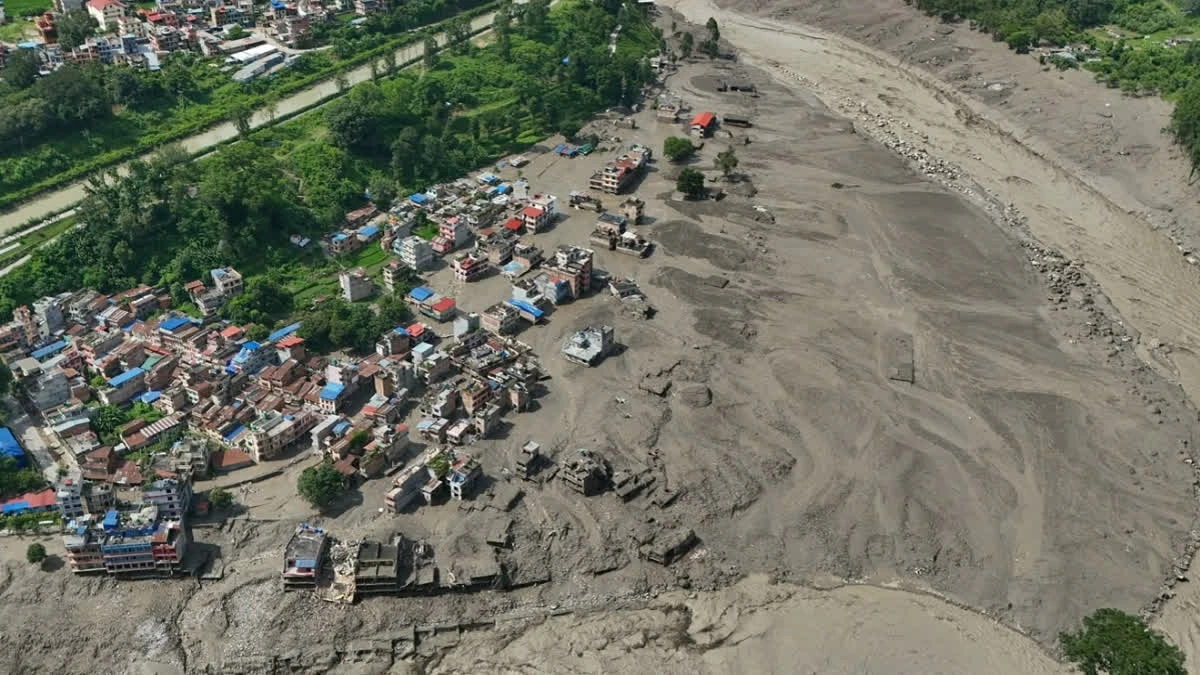
A catastrophic flood triggered by a glacier collapse has killed more than 360 people along the Nepal-China border, with over 1,400 still missing — including more than 500 foreign nationals from more than 30 countries — as rescue helicopters and military personnel search through destroyed roads, submerged buildings, and mud-covered valleys across the Himalayan region.
Videos of the disaster showed people running as the torrent — described as several storeys high — swept through communities within minutes on Wednesday. Buildings were swallowed to their second floors in Nepal’s Nuwakot district. Bridges and vehicles were buried. Debris hung from trees and overhead wires. Hundreds of survivors were found caked in mud. Bodies were recovered in Chitwan district, hundreds of kilometres downstream from the epicentre.
At least 910 people are missing in Nepal. Authorities in Tibet reported at least three dead and 558 missing. The UN’s humanitarian chief, Tom Fletcher, released $2 million from the Central Emergency Response Fund for medical care, shelter, and water, calling the floods “horrifying.” UN Secretary-General António Guterres pledged UN support for national relief efforts. China’s premier, Li Qiang, travelled to the border crossing at Gyirong to personally direct operations alongside 500 military and paramilitary personnel.
What Caused the Flood
The US Geological Survey initially detected a magnitude 4.4 earthquake near the Nepal-China border. It later revised that assessment, identifying the event as a magnitude 5.2 glacier collapse that sent enormous volumes of debris and meltwater flowing downstream. Climate experts at the Kathmandu-based International Centre for Integrated Mountain Development confirmed that an avalanche from a glacier most likely triggered the flash flood. Water levels on the Trishuli River rose by as much as 9 metres in half an hour at one measurement point.
In Tibet’s Shigatse prefecture, a mudslide struck near the Gyirong Port border crossing and engulfed a multistory port building, leaving mud more than 1.5 metres deep across surrounding areas. All roads to the crossing were damaged. Chinese state broadcaster CCTV warned that secondary collapses and landslides remain possible as rain continues in the area. A lake has formed at the confluence of two rivers on the China-Nepal border, and authorities warned it may burst.
The Himalayan region is among the most flood-vulnerable on earth. Melting glaciers — accelerated by human-caused climate change — have made glacial lake outburst floods increasingly common. A similar event in August 2025 overflowed a glacial lake in Tibet due to high temperatures, killing nine people and damaging critical cross-border infrastructure.
The Missing — Including Hundreds of Foreigners
Among those still unaccounted for are 517 foreign nationals, according to Nepal’s tourism board. The missing include 178 people from India, more than 60 from the United States, and nationals from at least 30 other countries including Ukraine, the UK, South Africa, and Japan. Many are believed to have been on pilgrimage to Mount Kailash in Tibet — a sacred site for Hindus, Buddhists, and others.
The US State Department confirmed 90 Americans are unaccounted for across Nepal and China, with three rescued and no confirmed American deaths as of Thursday. India’s Ministry of External Affairs reported 288 Indian nationals missing, including workers on a power project. Chinese officials said nearly 100 Chinese citizens are missing in Nepal, with 260 foreigners unaccounted for in Tibet.
Dozens of pilgrims from one group were caught at the immigration office at the Gyirong border crossing. An Indian spiritual leader said in an emotional video that the group included 22 Americans and nationals from multiple countries, and that no official information on their whereabouts had been received.
Nepal’s army has rescued more than 100 people by helicopter. The Nepal Red Cross has shifted its focus from rescue to large-scale relief as around 1,200 people remain displaced from at least three villages. Dozens of injured have been transported to Kathmandu for medical care.
Stay informed. Subscribe to the JournalTodays Newsletter for the latest disaster news, international coverage, and current affairs updates delivered straight to your inbox.